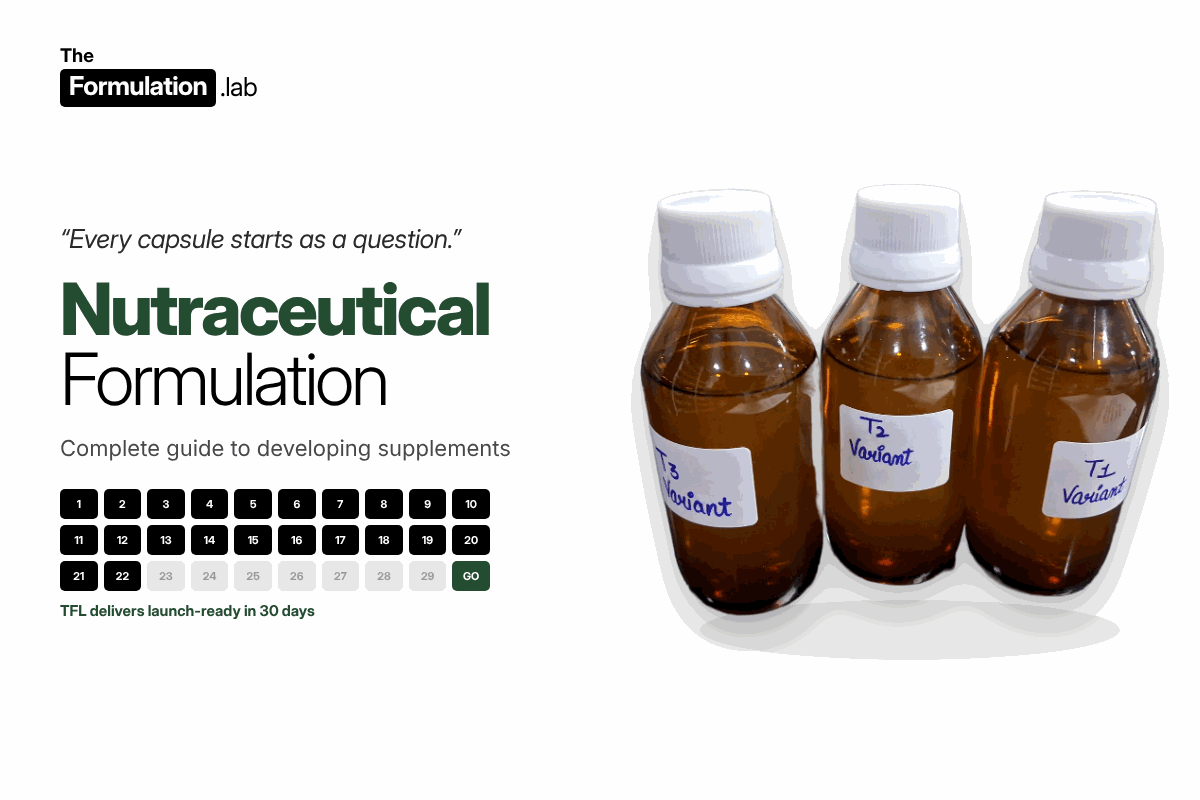
Nutraceutical formulation is the process of selecting, combining, processing and validating bioactive ingredients, nutrients and supporting excipients to create a safe, stable, manufacturable and fit-for-purpose nutraceutical product. It involves much more than deciding which ingredients to put into a capsule or powder. Developers must consider ingredient compatibility, dosage form, bioavailability, sensory properties, stability, processing, packaging, labelling and applicable regulatory requirements.For brands and product developers in India, effective nutraceutical product development connects the intended consumer benefit with a formulation that can actually be manufactured consistently and supported by appropriate evidence.
What Is Nutraceutical Formulation?
Nutraceutical formulation converts an intended nutritional or physiological function into a practical product specification.
The formulation process typically determines:
- Which active or bioactive ingredients are appropriate
- The amount of each ingredient per serving
- Suitable excipients and processing aids
- The appropriate dosage form
- Ingredient compatibility and stability
- Taste, texture, odour or mouthfeel where relevant
- Manufacturing process requirements
- Packaging requirements
- Testing and quality specifications
- Labelling and permissible claims
The starting point should therefore be the product objective and not simply a list of trending ingredients.For instance, a formulation intended as a daily powder may need to take a different approach to a capsule due to the fact that powder forms also have to consider dispersion, flavour, flowability, hygroscopicity and consumer acceptance.
How Does Nutraceutical Product Development Work?
A complete nutraceutical product development pathway extends beyond formulation itself. It moves from an initial product concept through feasibility, formulation, prototype development, testing, scale-up and commercialisation.
1. Define the product concept
The first stage establishes the intended consumer, product positioning, serving format, target benefit and commercial requirements.
A useful development brief may specify:
- Target consumer group
- Intended use occasion
- Desired dosage form
- Active ingredients under consideration
- Target serving size
- Sensory expectations
- Packaging format
- Target cost
- Expected shelf life
- Intended market
This prevents formulation decisions from being made independently of manufacturing and commercial constraints.
2. Conduct formulation and technical feasibility assessment
Before developing laboratory prototypes, the concept should be checked for technical feasibility.
The assessment may consider:
- Whether the proposed ingredients are suitable for the intended product category
- Whether the target dose can realistically fit the selected dosage form
- Ingredient availability and quality specifications
- Compatibility between active ingredients
- Expected stability risks
- Sensory challenges
- Processing requirements
- Preliminary manufacturing feasibility
- Target cost and serving economics
This stage can prevent substantial development work from being invested in a product concept that is difficult to manufacture or commercially impractical.
3. Select and assess ingredients
Ingredient selection should consider more than the perceived benefit of an ingredient.
Developers may assess:
- Identity and specification
- Purity and quality
- Active concentration
- Solubility or dispersibility
- Hygroscopicity
- Particle size
- Oxidative sensitivity
- Thermal sensitivity
- Interaction with other ingredients
- Stability during storage
- Regulatory suitability
Bioavailability also requires careful interpretation. A high amount of an ingredient in a formulation does not necessarily mean that it will be absorbed or utilised efficiently by the body. The form of an ingredient, the matrix it is in, the processing conditions, and interactions can all impact performance.
4. Select the dosage form
Nutraceutical dosage forms should be selected according to the formulation, dose, consumer requirements and manufacturing feasibility.
| Dosage Form | Key Formulation Considerations |
|---|---|
| Powder | Flow, moisture control, dispersibility, taste and segregation |
| Capsule | Powder flow, fill weight, density and dose limitations |
| Tablet | Compression behaviour, hardness, friability, disintegration and excipient compatibility |
| Sachet | Fill accuracy, moisture protection, seal integrity and powder behaviour |
| Liquid | Solubility, suspension stability, microbial control and packaging compatibility |
A dosage form may impose practical limits on the amount of active material that can be delivered in a single administration. Thus, dosage form selection must be made as a part of initial development rather than as a post-development packaging decision.
5. Develop the initial formulation
Once the ingredients and dosage form have been selected, the formulation can be translated into a laboratory prototype.
This stage may involve determining:
- Active ingredient levels
- Excipient types and concentrations
- Flavouring or taste-masking systems
- Sweetening systems where applicable
- Processing sequence
- Mixing conditions
- Target physical properties
- Serving size
- Preliminary product specifications
The first formulation should be treated as a development starting point rather than a final commercial recipe. Testing will often identify variables that need optimisation.
6. Develop and optimise prototypes
Prototype development converts the initial formula into a product that can be evaluated under realistic conditions.
Multiple prototype iterations may be required to address issues such as:
- Poor dispersion
- Sedimentation
- Caking
- Poor powder flow
- Tablet defects
- Unacceptable taste
- Odour
- Colour
- Mouthfeel
- Inconsistent appearance
- Active ingredient stability
Changes to one variable can affect others. Increasing an excipient, changing an ingredient source, or modifying processing conditions may improve one property while creating another problem.
Nutraceutical Formulation Decision Framework
A formulation decision framework helps product teams move from an ingredient concept to a commercially viable product without treating formulation as a simple recipe-building exercise.
| Decision Stage | Key Question | What to Evaluate | Typical Output |
|---|---|---|---|
| Product objective | What should the product deliver? | Target consumer, intended use, positioning and desired benefit | Product brief |
| Technical feasibility | Can the concept be developed as intended? | Dose, ingredient suitability, compatibility, sensory and manufacturing constraints | Feasibility assessment |
| Ingredient selection | Which ingredients are technically and commercially suitable? | Quality, dosage, evidence, regulatory status, compatibility and supply | Ingredient shortlist |
| Dose feasibility | Can the intended dose fit the chosen format? | Serving size, active concentration, bulk density and dose limitations | Target composition |
| Dosage form | Which delivery format is appropriate? | Powder, capsule, tablet, sachet or liquid; sensory and manufacturing constraints | Dosage-form decision |
| Formulation design | Can the ingredients work together? | Excipients, interactions, solubility, flow, taste and processing behaviour | Initial formulation |
| Prototype optimisation | Does the prototype perform as intended? | Sensory attributes, physical properties, assay and process behaviour | Optimised prototype |
| Validation testing | Does the formulation meet defined specifications? | Active content, physical properties, microbiology and other relevant parameters | Validated formulation |
| Stability and packaging | Will the product remain within specification? | Moisture, oxidation, degradation, packaging protection and storage conditions | Stability strategy |
| Pilot manufacturing | Does the formula behave consistently beyond the laboratory? | Mixing, filling, compression, yield and process controls | Pilot batch |
| Scale-up | Can commercial equipment reproduce the required quality? | Batch size, process parameters, uniformity and production efficiency | Scaled process |
| Regulatory and claims review | Can the product be presented as intended? | Product category, ingredients, labelling and applicable claims requirements | Launch-ready specification |
| Commercial assessment | Does the formulation make economic sense? | Ingredient cost, packaging, manufacturing cost, yield and target price | Commercialisation decision |
The framework should not always be treated as a rigid linear sequence. Development often moves backwards when testing identifies a problem. Poor stability, for example, may require a change in ingredient form or packaging, while unacceptable taste may require reformulation or a different dosage form.The key decision is whether the product can satisfy four requirements simultaneously: product performance, consumer acceptability, manufacturing feasibility and regulatory suitability.
Key Formulation Challenges
1.Ingrsedient compatibility
Multiple active ingredients can physically or chemically interact. One ingredient can influence another via moisture, pH, oxidation, adsorption or other effects.For example, moisture-sensitive ingredients can cause problems in a powder blend if the formulation or package permits moisture ingress. Oxidation-sensitive ingredients may need appropriate processing controls and package protection.Compatibility testing can therefore reveal if an apparently attractive combination of ingredients is technically feasible.
2.Excipients and processing aids
Excipients influence manufacturing behaviour as well as the final product.Depending on the dosage form, they may support:
- Powder flow
- Binding
- Disintegration
- Bulk density
- Anti-caking performance
- Stability
- Palatability
- Processing consistency
The correct excipient level depends on the formulation and manufacturing process. Excessive use may affect dose uniformity, sensory properties, product weight or consumer acceptance.
3.Taste masking and sensory performance
Taste is a significant formulation variable if a product contains minerals, botanical extracts, amino acids, proteins or other ingredients that possess a bitter, astringent or objectionable odour.Taste masking can involve changes in the form of the ingredients, the flavour system, sweetening, processing or dosage form. Sensory evaluation is an important tool, since a chemically acceptable formulation may not be commercially successful if consumers find the formulation difficult to consume consistently.
Sensory Evaluation and Product Acceptance
Sensory evaluation should be incorporated before a formulation is treated as commercially ready, particularly for powders, liquids, chewable products and other products where taste or mouthfeel directly affects usage.
Evaluation may examine:
- Taste intensity
- Bitterness or astringency
- Aftertaste
- Aroma
- Mouthfeel
- Texture
- Ease of consumption
- Appearance
The aim is not to select the best-tasting prototype. The sensory results must be seen in the context of the active dosage, stability, constraints on the ingredients and production costs.A formulation may thus have to go through several optimisation cycles to achieve a proper balance between the sensory profile and the technical aspects
Stability and Shelf Life
Stability should be considered during formulation rather than after the product has already been finalised.
Potential changes include:
- Active degradation
- Oxidation
- Moisture uptake
- Colour changes
- Odour development
- Loss of potency
- Caking
- Phase separation in liquids
- Changes in tablet performance
- Microbiological deterioration where applicable
A stability programme should reflect the formulation, packaging and intended storage conditions for the product. Tests may be performed to assess relevant chemical, physical, microbiological and sensory parameters over time.Packaging is an integral part of this system. A moisture-sensitive powder may require different protection to that required by an oxidation-sensitive ingredient, whereas liquid products require consideration of container compatibility, closure performance and storage conditions.Where there is uncertainty about shelf life behaviour, professional stability testing can help to identify what parameters need to be monitored and whether the proposed combination of formulation and packaging is appropriate.
Testing and Validation
Testing should be based on the product’s risk profile and specifications.
Depending on the formulation, development may involve
- Identity and purity testing
- Assay of active ingredients
- Microbiological testing
- Moisture analysis
- Physical testing
- Heavy metal or contaminant assessment where relevant
- Stability testing
- Sensory evaluation
- Packaging compatibility studies
The objective is not simply to generate a certificate of analysis. Testing should answer practical development questions: Does the formulation meet its specification? Does it remain stable? Can the process deliver a consistent dose? Does the packaging protect the product throughout its intended shelf life?
Pilot Manufacturing and Scale-Up
Laboratory formulation should be followed by pilot evaluation when production behaviour cannot be confidently predicted from small-scale trials.
A pilot batch can reveal differences in:
- Mixing efficiency
- Blend uniformity
- Heat exposure
- Shear
- Residence time
- Powder flow
- Compression behaviour
- Filling accuracy
- Yield
- Batch-to-batch consistency
For powders and capsules, there is the risk of segregation if there are significant differences in the particle size, density or flow properties of ingredients. For tablets, compression parameters will influence hardness and disintegration. With liquid products, control of mixing sequence, temperature, viscosity and dispersion may be required.Scale-up must therefore define which parameters in the laboratory need to be translated to production controls. A formulation that works well at a small-scale trial should not be assumed to behave identically at an industrial scale.This is where supplement formulation in India needs to be considered alongside manufacturing feasibility. Development should account for the actual production process rather than transferring an unchanged laboratory recipe into a larger batch.
Packaging Development
Packaging should be evaluated as part of product development because the package can influence shelf life and product quality.
Relevant considerations may include:
- Moisture barrier
- Oxygen protection
- Light protection
- Container-product compatibility
- Closure integrity
- Fill volume
- Ease of use
- Protection during transportation
- Storage conditions
For example, a hygroscopic powder may require stronger moisture protection than a formulation with relatively low moisture sensitivity. Packaging selection should therefore follow an understanding of the product’s stability risks.
FSSAI and Labelling Considerations in India
In India, health supplements and nutraceuticals are subject to the jurisdiction of the Food Safety and Standards Authority of India (FSSAI). The applicable regulatory framework includes the Food Safety and Standards (Health Supplements, Nutraceuticals, Food for Special Dietary Use, Food for Special Medical Purpose, Functional Food and Novel Food) Regulations, 2016, as amended and implemented.Depending on their composition and type, products might need to be assessed according to a specific pathway. In that regard, it is recommended that the eligibility of ingredients, conditions of use, specification, and labelling, as well as claims, be considered in light of the applicable requirements prior to commercialisation.Particular care should be given to claims. A formulation should not be driven by a marketing claim that may not be appropriately substantiated or authorised.
Regulatory review may need to consider:
- Product category
- Ingredient status
- Permitted quantities and conditions
- Required declarations
- Nutrition information
- Usage instructions
- Warnings and precautions
- Claims and advertising requirements
- Packaging and labelling requirements
Because regulatory requirements can change, current official requirements should always be verified before launch.
Commercialisation and Manufacturing Readiness
The final formulation should be evaluated against both technical and commercial requirements before routine production begins.
Key questions include:
- Can the required ingredients be sourced consistently?
- Can the product be manufactured within the target cost?
- Does the process deliver acceptable yield?
- Can active content remain within specification across batches?
- Is the packaging commercially practical?
- Has the expected shelf life been supported by appropriate testing?
- Are production specifications documented?
- Are critical process parameters defined?
- Has the product been reviewed for applicable regulatory and labelling requirements?
Commercialisation is therefore the point where formulation, manufacturing, quality, packaging, regulatory requirements and economics need to align.
Common Nutraceutical Formulation Mistakes
Several development problems can be reduced by addressing technical questions early.
- Choosing ingredients based only on market popularity
- Skipping technical feasibility assessment
- Designing the formula before deciding the dosage form
- Ignoring taste until the final prototype
- Using incompatible ingredients in the same blend
- Treating laboratory performance as proof of production feasibility
- Moving directly from laboratory trials to commercial production
- Setting a shelf-life target without stability evidence
- Developing claims separately from regulatory review
- Underestimating packaging requirements
- Failing to establish measurable product specifications
- Ignoring production yield and cost during formulation
The cost of correcting these issues usually increases as development progresses from laboratory trials to pilot production and commercial batches.
When Is Specialist Formulation Support Useful?
Professional technical support is of value when the product comprises multiple actives, challenging sensory characteristics, uncertain stability, complex dose requirements or difficult scale-up conditions.A formulation specialist can assess ingredient interactions, dosage feasibility, excipient selection, processing performance and prototype performance. Development support can be extended to sensory testing, stability studies, process optimisation, pilot manufacturing, scale-up, and specification development.For businesses comparing nutraceutical formulation services, the useful question is not simply whether a provider can produce a recipe. It is whether the development process addresses formulation science, testing, manufacturing feasibility, documentation and commercial scale-up.Similarly, businesses evaluating a nutraceutical product development company or nutraceutical contract manufacturing India pathway should assess how formulation decisions connect with actual production requirements.
A Practical Development Checklist
Before moving a nutraceutical concept toward commercial production, confirm that the following have been addressed:
- Product objective and target consumer
- Technical and commercial feasibility
- Ingredient identity and quality
- Ingredient compatibility
- Suitable dosage form
- Active dosage and serving size
- Excipients and processing requirements
- Prototype development and optimisation
- Sensory performance where relevant
- Product specifications
- Laboratory testing
- Stability and shelf-life strategy
- Packaging compatibility
- Pilot manufacturing
- Scale-up requirements
- Manufacturing process controls
- Regulatory and labelling review
- Cost and production economics
- Commercialisation readiness
A structured review at each development stage can identify technical gaps before they become expensive manufacturing problems.
Conclusion
Effective nutraceutical formulation is only one part of successful supplement development. A commercially viable product must progress through concept definition, feasibility assessment, ingredient selection, dosage-form design, formulation, prototype optimisation, sensory evaluation, testing, stability assessment, packaging development, pilot manufacturing, scale-up and regulatory review.The most robust development pathway maintains the chain of these decisions. The choices of ingredients will dictate dosage form; dosage form will dictate manufacturing; processing can impact stability; packaging can impact shelf life, and all of these considerations impact the cost and commercial viability.For startups and product teams beyond the initial concept, the next steps may involve assessing formulation feasibility, definition of testing requirements, optimisation of a proof of concept or evaluation of the path from laboratory development to manufacturing.
Book a Free Nutraceutical Consultation to discuss formulation requirements, development priorities and the appropriate technical pathway.
Develop Your Nutraceutical Product With Expert Guidance
Planning to launch a supplement? Get expert help with ingredients, formulation, dosage forms, taste, stability, and product development. Discuss your concept with our team.
Frequently Asked Questions
1. What is nutraceutical formulation?
Nutraceutical formulation is the process of designing a nutraceutical product by selecting suitable active ingredients, excipients, dosage levels and delivery formats while considering stability, safety, sensory properties, manufacturing and regulatory requirements. It converts a product concept into a technically defined formulation that can be tested and developed for production.
2. What is the difference between nutraceutical formulation and supplement formulation?
The terms are frequently used interchangeably in the commercial field, but regulatory practice is explicitly dependent on the particular product and its requirements. Both require choosing the ingredients, establishing the dose and developing an appropriate format for delivery, but nutraceutical formulation may include additional ingredients for specific activity and positioning.
3. Why is nutraceutical formulation important?
Nutraceutical formulation defines whether ingredients can be formulated into a stable, acceptable and manufacturable product. Poor formulation decisions can result in issues such as poor flow characteristics, poor taste, degradation, inconsistent dosing, caking or inadequate shelf-life performance.
4. What ingredients can be used in nutraceutical formulation?
Depending on the type of product and the rules for this particular type, formulas can include ingredients such as nutrients, vitamins, minerals, amino acids, botanicals and other ingredients that are allowed to be used. Every single ingredient has to be evaluated in terms of regulation, quality, dose, compatibility and stability before it is placed in a formulation.
5. How is the right nutraceutical dosage form selected?
The dosage form is dictated by the active dose, properties of the ingredients, target consumer, sensory demands, stability, and the manufacturing process. Each of the powder, capsules, tablets, sachets, and liquids produces distinct technical limitations and should be chosen during the initial stages of developing the product.
6. How long does nutraceutical product development take?
There is no single development timeline since development is different for different formulations, dosage forms, tests, stability programme and manufacturing route. A simple formulation may involve fewer steps in its development than a multiple-ingredient product which requires extensive optimisation, stability evaluation and scale-up.
7. Why is bioavailability considered during formulation?
Bioavailability relates to how much of an ingredient becomes available to the body. The form of the ingredient, and how this interacts with the matrix, solubility, interactions and processing all play a role; therefore, formulation decisions should take into account the proposed use of an ingredient, not just its nominal quantity.
8. How is nutraceutical stability tested?
Stability testing involves the examination of selected physical, chemical, microbiological and sensory properties during specified storage conditions and time intervals. The parameters to be investigated are defined according to the formulation, active substances, primary packaging and potential failure modes.
9. Can a nutraceutical formulation be scaled directly from laboratory production?
Not always. Laboratory batches may differ from larger ones because mixing, heat transfer, shear, residence time, powder flow w, and filling conditions can vary at different scales; therefore, pilot trials and process optimisation may be required prior to going into commercial production.
10. What should be checked before launching a nutraceutical product in India?
The product category, ingredient eligibility, formulation, dosage, label, claims, testing, packaging, manufacturing process and applicable FSSAI requirements should be reviewed prior to launch. Existing regulatory provisions should be validated due to changing requirements and amendments over time.