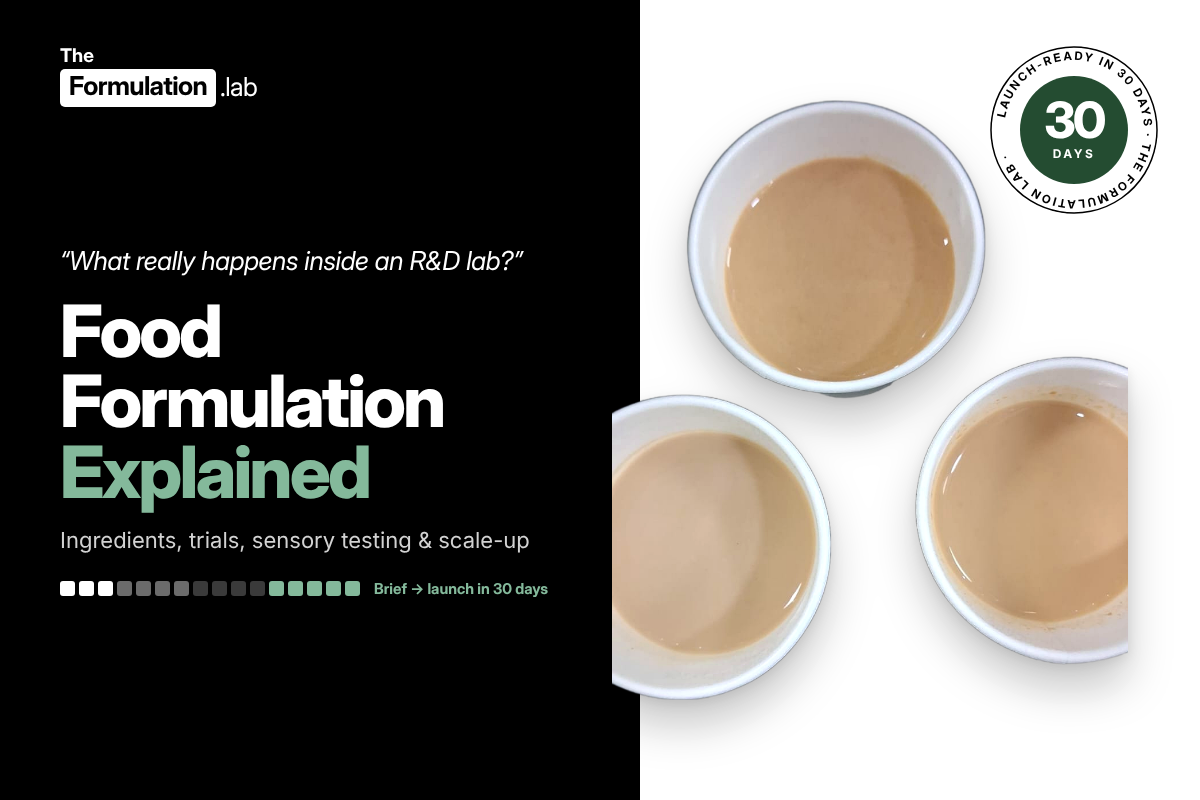
A successful food product requires more than a good recipe. Food formulation combines ingredient selection, functionality, processing, sensory performance, safety, stability, cost and manufacturing requirements into a product that can be reproduced consistently. A structured food formulation process therefore moves from a product brief and bench-top trials through sensory and analytical validation, pilot production, scale-up and commercialisation.For a food business, the objective is not simply to create a product that works once. The objective is to develop a formulation that can be manufactured consistently, meet defined quality requirements, remain stable through its intended shelf life and support a viable commercial cost.
What Is Food Formulation?
Food formulation is the systematic development and optimisation of a food product by selecting ingredients, defining their quantities and functions, establishing processing conditions and validating the resulting product against technical, sensory and commercial requirements.Ingredients are selected for more than flavour or nutrition. They may provide structure, emulsification, viscosity, sweetness, acidity, moisture control, stability, colour, aeration, preservation or processing performance.
A formulation therefore connects several variables:
- Ingredient functionality and compatibility
- Product texture and sensory profile
- pH, Brix, moisture and water activity
- Processing temperature, time and shear
- Microbiological stability
- Packaging requirements
- Shelf life
- Manufacturing yield
- Cost per kg
- Finished-product specifications
This is why a formulation that performs well in a kitchen or laboratory may still require substantial development before it is ready for commercial production.
What Does a Food Formulation Process Include?
A practical food formulation process usually includes:
- Product brief and technical feasibility
- Ingredient selection and specification review
- Bench-top prototype trials
- Sensory evaluation and optimisation
- Analytical and stability testing
- Pilot-batch development
- Scale-up and process validation
- Pre-commercialisation review
- Manufacturing transfer and commercial production
The exact sequence varies by product category, but the development logic remains similar: define measurable targets, develop prototypes, test them, optimise the formulation, validate the process and confirm commercial feasibility.
Product-Category Decision Framework
Different food categories require different development priorities.
| Product Category | Primary Development Focus | Important Variables | Typical Testing Priorities |
|---|---|---|---|
| Beverages | Solubility, suspension and stability | pH, Brix, viscosity, emulsification | pH, Brix, viscosity, sedimentation, microbiology |
| Sauces and dressings | Viscosity and emulsion stability | Oil-water ratio, shear, hydrocolloids, emulsifiers | pH, viscosity, separation, microbiology |
| Bakery | Structure and moisture management | Hydration, starch, protein, fat, baking conditions | Moisture, texture, volume, sensory |
| Snacks | Crispness and moisture control | Water activity, oil uptake, particle size | Water activity, moisture, texture, oxidation |
| Confectionery | Solids and texture control | Sugar concentration, temperature, crystallisation | Solids, moisture, water activity, texture |
| Dairy and dairy alternatives | Protein and physical stability | Protein, pH, heat treatment, fat, stabilisers | pH, viscosity, microbiology, stability |
| Powder blends | Uniformity and flow | Particle size, density, moisture, hygroscopicity | Blend uniformity, moisture, flow, reconstitution |
| Ready-to-eat foods | Safety and process robustness | pH, water activity, thermal processing | Microbiology, pH, water activity, shelf life |
| Frozen foods | Freeze-thaw stability | Water distribution, solids, freezing conditions | Texture, moisture migration, sensory |
This framework helps determine which tests should be prioritised rather than applying the same testing programme to every product.
Founder-Ready Food Development Roadmap
1. Product Brief and Feasibility
Define the desired product, use by consumer, sensory properties, nutritional or functional objectives, pack format, storage conditions, expected shelf life and target cost.Initial technical assessments should include: availability of ingredients, specifications for ingredients, processing requirements and possible problems with incompatibility.
Output: A defined product brief and development plan.
2. Ingredient Selection and Prototype Design
Ingredients need to be considered in terms of their function, specification, compatibility and commercial availability.Depending on the product, preliminary assessments may include solubility, dispersion, hydration, moisture, pH, Brix and interaction checks.
Output: Selected ingredient candidates and an initial bench-trial plan.
3. Bench-Top Prototype Trials
Small-scale trials allow the development team to compare formulation variables without committing to full production.
Each trial should document:
- Formula version
- Ingredient quantities and specifications
- Processing sequence
- Temperature and time
- Mixing conditions
- Yield
- Sensory observations
- Analytical measurements
Relevant testing may include pH, Brix, moisture, water activity, viscosity, texture and preliminary microbiological evaluation where appropriate.
Output: Shortlisted prototypes with measurable performance data.
4. Sensory Testing and Optimisation
Sensory testing of food should be structured around attributes relevant to the product, such as appearance, aroma, flavour, sweetness, acidity, mouthfeel, texture and aftertaste.
Coded samples with consistent evaluation criteria are used to facilitate comparisons. As a result, the sensory results should be considered in addition to the analytical data. For example, if a product is receiving good sensory feedback but possibly has an unresolved stability or processing issue.
Output: An optimised prototype with defined sensory and technical targets.
5. Analytical and Stability Validation
Once a formulation is sufficiently developed, testing becomes more focused.
Depending on the product, validation may include:
- pH
- Brix
- Water activity
- Moisture
- Viscosity
- Texture
- Microbiological quality
- Nutritional composition
- Active or nutrient content
- Oxidative stability
- Physical stability
Storage studies should evaluate whether important quality characteristics remain within acceptable limits over time.
Output: Evidence supporting product quality and stability.
6. Pilot Batch and Scale-Up
Scale-up need not merely be a proportional increase in the quantity of each ingredient. The efficiency of mixing, heat transfer operations, hydration, shear, order of introduction of ingredients, holding time, filling and yield can all alter in different ways with changes in equipment and batch sizes.
A pilot batch should therefore compare the scaled process against the approved prototype.
Check:
- pH and Brix
- Moisture and water activity
- Viscosity or texture
- Yield
- Sensory characteristics
- Microbiological quality where relevant
- Processing parameters
- Filling and packaging performance
This is where food recipe scaling becomes a process-engineering exercise rather than a mathematical calculation.
Output: A pilot-validated formulation and process.
The Pre-Commercialisation Gate
Before moving into routine commercial production, the product should pass a defined pre-commercialisation gate.
This gate answers one central question:Is the product technically validated, commercially feasible and sufficiently documented to enter manufacturing?
A pre-commercialisation review should confirm:
| Area | Gate Requirement |
|---|---|
| Formulation | Final formula and ingredient specifications approved |
| Product quality | Finished-product specifications established |
| Process | Critical processing parameters documented |
| Sensory | Approved sensory profile defined |
| Testing | Required analytical and microbiological testing completed |
| Stability | Shelf-life strategy and supporting evidence established |
| Packaging | Pack compatibility and filling requirements confirmed |
| Cost | Manufacturing cost and expected yield assessed |
| Sourcing | Critical ingredients available at commercial requirements |
| Documentation | Product and manufacturing documentation complete |
| Compliance | Applicable regulatory and labelling requirements reviewed |
If a critical item has not been resolved, the product should be returned to the appropriate stage of development instead of moving on to normal production.This gate stops projects getting to the point where a promising prototype has been sent to manufacturing without having fully worked out the technical, cost, packaging and documentation requirements.
Commercialisation: From Validated Prototype to Manufacturing
Once the pre-commercialisation gate is passed, the focus shifts from development to controlled commercial execution.
Manufacturing Transfer
The development package should provide enough information for production teams to reproduce the approved product consistently.
It may include:
- Master formulation
- Raw-material specifications
- Batch size
- Ingredient addition sequence
- Mixing and processing parameters
- Critical process controls
- Expected yield
- In-process checks
- Finished-product specifications
- Packaging instructions
- Storage conditions
- Sampling requirements
A pilot or pre-commercial batch should be compared with the approved reference product.
Commercial Cost and Yield Validation
The commercial cost should be based on actual production conditions rather than theoretical ingredient calculations alone.
Consider:
- Raw materials
- Ingredient losses
- Processing yield
- Packaging
- Testing
- Production inputs
- Rejected or reworked material where applicable
- Batch size
- Storage requirements
A formulation with a low theoretical ingredient cost may become commercially unattractive if it produces excessive losses, poor yield or expensive packaging requirements.
Packaging and Distribution Readiness
Final packaging should be considered an integral element of the final product system. Influences such as moisture transmission, oxygen exposure, light sensitivity, seal integrity, filling compatibility and storage may impact the product performance.Shelf-life verification should consider intended packaging and storage and distribution conditions.
Launch Readiness
Before launching the technical file commercially, ensure continued manufacturing and quality release, for example, the final formulation, ingredients, finished product specifications, test data, shelf-life, packaging and appropriate labelling documentation.For products sold in India, applicable regulatory and labelling requirements should be identified in accordance with current requirements for that category of product, prior to launch.
Food Formulation vs Recipe Development
Recipe development generally focuses on creating a desirable product. Commercial food recipe development goes further by considering reproducibility, ingredient specifications, processing, stability, yield and manufacturing economics.A recipe can tell someone what ingredients to combine. A commercial formulation needs to define how the product should perform and how that performance can be reproduced at scale.
Key Measurements During Development
1.Water Activity
Water activity indicates how much water is available to support microbial activity and influence product stability. It can be particularly important for snacks, bakery products, powders and shelf-stable foods.
2.pH and Brix
pH can influence microbial stability, flavour, protein behaviour and preservative performance. Brix is commonly used to assess soluble solids in products such as beverages, sauces and fruit-based systems.
3.Texture Analysis
Texture measurements can help establish objective targets for hardness, firmness, crispness or other product-specific characteristics. These measurements become especially valuable when sensory expectations need to be translated into manufacturing specifications.
Common Food Formulation Mistakes
Several development problems repeatedly create delays:
- Changing multiple variables without documenting trial conditions
- Selecting ingredients without reviewing technical specifications
- Performing extensive testing before the formulation is sufficiently developed
- Waiting until the end to evaluate cost
- Assuming laboratory performance will automatically translate to production
- Treating pilot production as a formality
- Developing packaging separately from product stability
- Launching without clearly defined finished-product specifications
Good development controls the number of variables being changed at each stage and uses testing to answer specific technical questions.
Practical Founder Checklist
Before approving commercial production, confirm:
- Is the final formulation documented?
- Are ingredient specifications approved?
- Are sensory targets defined?
- Are finished-product specifications established?
- Has pilot production been completed?
- Has yield been verified?
- Are critical process parameters documented?
- Has relevant stability testing been addressed?
- Is packaging compatible with the product?
- Is the actual manufacturing cost understood?
- Are sourcing requirements realistic?
- Are regulatory and labelling requirements addressed?
- Can the product be reproduced consistently from the documentation?
If several answers are still uncertain, further development may be required before commercial production.
Conclusion
Food formulation is a controlled development process that connects ingredients, processing, sensory quality, testing, scale-up and commercial requirements. The best development programmes do not stop upon achieving a formulation that has been approved at a prototype stage. They define measurable specifications, validate the formulation under realistic processing conditions, check packaging and stability, evaluate yield and cost and then move the product through a clear pre-commercialisation gate.This process ensures that the transition from bench-top to manufacturing development is better defined and provides founders, product teams and manufacturers with greater confidence to assess when a product is truly ready for market.
Bring Your Product Idea to Life With Expert Guidance
Planning to develop a new food, beverage, or nutraceutical product? Our team can help you explore formulation options, ingredient selection, product feasibility, testing requirements, and the next steps towards commercialisation. Contact us to discuss your project.
FAQs
1. What is food formulation?
Food formulation refers to developing a food product by choosing ingredients, setting their quantities and their function, determining the process and validating the end product according to sensory, technical, safety, stability and commercial requirements.
2. What does a food formulation process include?
A food formulation process can include product briefing, feasibility assessment, ingredient selection, bench trials, sensory testing, analytical testing, optimisation, pilot production, scale-up, stability evaluation and commercialisation planning.
3. How long does food formulation take?
The timelines vary depending upon the complexity of the product, the number of iterations required in the prototype development, availability of ingredients, testing and shelf-life requirements and manufacturing scale-up requirements. The timelines for simple products could be lesser than those for products requiring extensive stability or process validation.
4. What is the difference between food formulation and recipe development?
Recipe development focuses primarily on creating the desired product. Commercial formulation also considers ingredient specifications, processing conditions, reproducibility, stability, quality standards, yield and manufacturing economics.
5. Why are bench-top trials important?
Bench-top trials allow developers to test ingredient ratios and processing conditions efficiently before committing to larger production quantities. They also provide controlled comparisons between prototype versions.
6. How do hydrocolloids affect food formulations?
Hydrocolloids can influence viscosity, suspension, water binding, mouthfeel, gel structure and physical stability. Their effect depends on type, concentration, hydration conditions, pH, temperature and interactions with other ingredients.
7. Why is sensory testing needed alongside laboratory testing?
Laboratory testing measures defined technical characteristics, while sensory testing determines how consumers or trained evaluators perceive attributes such as flavour, aroma, texture and mouthfeel. Both perspectives can be necessary when optimising a commercial product.
8. What is involved in scaling a food formulation?
Scale-up involves more than increasing ingredient quantities. Mixing, heat transfer, hydration, shear, processing time, ingredient addition, yield, filling and equipment characteristics may change with production scale.
9. How is food formulation cost calculated?
Formulation cost can begin with ingredient cost but should ultimately consider commercial yield, ingredient losses, packaging, processing inputs, testing, batch size and other relevant production costs.
10. When should a food business seek professional formulation support?
Professional support can be beneficial when a product requires technical optimisation, structured testing, scale-up, stability validation, packaging evaluation, manufacturing transfer or commercialisation planning, especially when there is a need to move the product reliably from prototype to repeatable production.