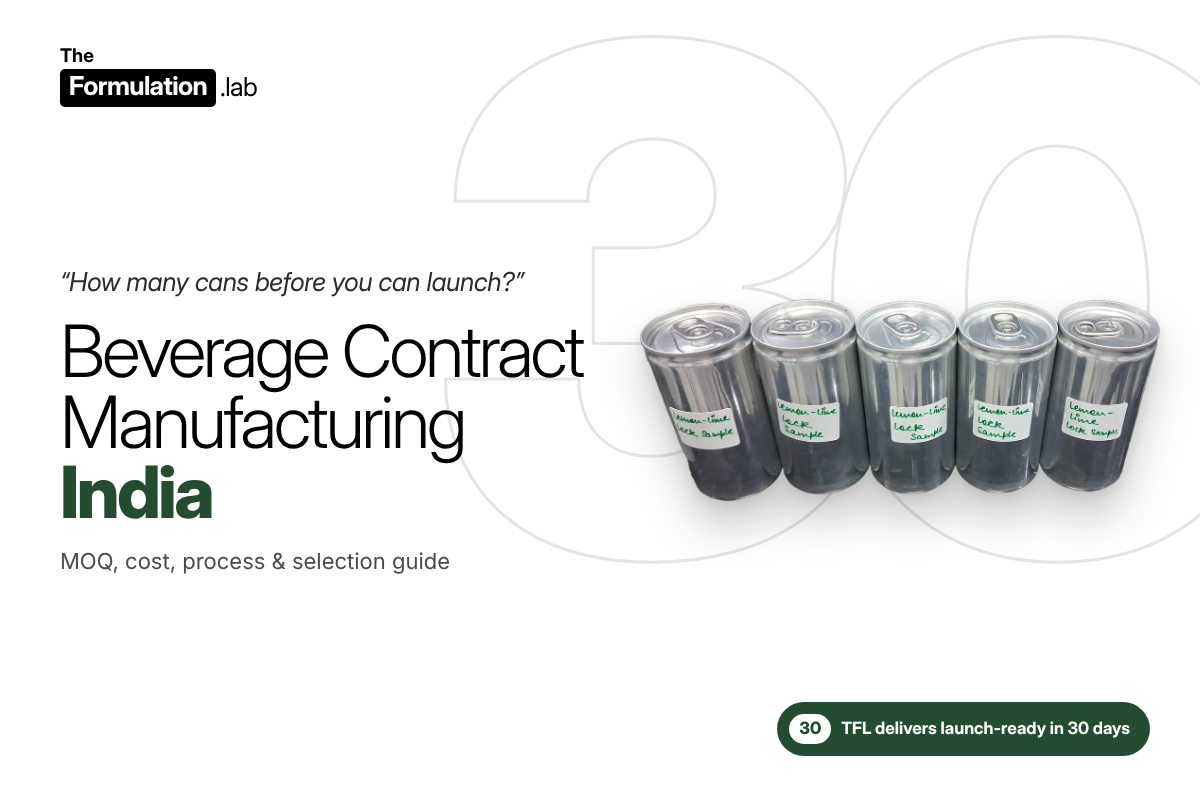
For brands evaluating beverage contract manufacturing India, MOQ can be complicated as it almost never constitutes one number. It depends on the format of the beverage, the size of the batch, packaging, technology for filling, purchasing of ingredients, economics of the production line and whether the product is already production-ready. A contract manufacturer for beverages may calculate MOQ in litres, number of bottles, cans or batches. The price is also dependent on the project, as the formulation, packaging, testing, setup, waste and volumes of production play a role. As a buyer, it is important to consider the MOQ, technical feasibility, cost of the landed product and quality controls in unison.
What is beverage contract manufacturing?
Beverage contract manufacturing is a production arrangement in which a brand engages an external manufacturing facility to produce beverages according to an agreed formulation, specification, packaging format and quality requirements.
Depending on the arrangement, the manufacturer may handle some or all of the following:
- Ingredient sourcing or receiving
- Batch preparation
- Blending and processing
- Pasteurisation or other preservation treatment
- Bottling, canning or pouch filling
- Labelling and secondary packing
- In-process quality checks
- Finished-product testing
- Batch documentation
- Warehousing or dispatch coordination
The scope varies considerably. A beverage contract manufacturer India search may therefore return businesses with very different capabilities. One facility may specialise in carbonated drinks, while another may be better suited to juice-based beverages, functional drinks, dairy beverages, powdered mixes or shelf-stable RTD products.This distinction matters because manufacturing capability should be matched to the product rather than selected only on quoted unit price.
What is the MOQ for beverage contract manufacturing in India?
There is no universal MOQ for beverage manufacturing in India. A realistic MOQ is determined by the manufacturer’s production line, packaging format, batch economics, ingredient requirements and the number of SKUs being produced.
Factors that can increase or reduce MOQ include:
- Bottle, can, pouch or carton format
- Pack size and filling-line configuration
- Number of flavours or variants
- Custom packaging requirements
- Special ingredients requiring dedicated procurement
- Minimum packaging-material purchase quantities
- Batch preparation and cleaning requirements
- Production-line setup time
- Whether the formulation is standardised or custom-developed
- Expected production frequency
For example, a buyer requesting several flavours in relatively small quantities may face higher effective minimums because each flavour can require separate preparation, cleaning, testing and packaging setup.A better question than simply asking “What is your MOQ?” is: What is the minimum economically viable production run for this exact beverage, pack format and SKU count?
That gives a more useful basis for comparing manufacturers.
How the beverage manufacturing process works
The beverage manufacturing process should be understood as a controlled sequence rather than simply filling liquid into containers.
1. Product and manufacturing specification
Before production commences, the manufacturer requires a defined product specification, including ingredients, desired sensory properties, physical and chemical parameters, packaging, batch size and storage conditions.If the formulation is still being developed, manufacturing quotations may be tentative, since process conditions and raw material requirements are still subject to change.
2. Ingredient preparation and batching
Ingredients are weighed and prepared according to the approved formulation. The quality of water used, the solubility of ingredients, the order in which they are added and the mixing conditions can have an effect on the finished beverage.Some ingredients can interact with minerals, proteins, acids, flavours or stabilisers. A formulation that works in a small laboratory batch may therefore need to be adjusted before commercial production.
3. Processing
Processing depends on the beverage category and required shelf stability.
Possible technologies include:
- Hot fill
- Pasteurisation
- Aseptic filling
- Carbonation
- Homogenisation
- Controlled thermal processing
- Cold processing where appropriate
The selected process affects flavour, colour, nutrient retention, microbial safety, viscosity and packaging requirements.
4. Filling and packaging
Bottling and filling must be compatible with the beverage and container. The material of the bottle, closure system, oxygen exposure, headspace and filling temperature can affect product stability.Packaging should be selected during development, rather than as a last-minute purchasing decision.
5. Quality release
Finished batches may be submitted for tests according to the product specification and applicable requirements. Depending on the beverage, the test may include microbiological parameters, pH, acidity, soluble solids, preservatives, nutritional parameters or other characteristics.
What determines beverage contract manufacturing cost in India?
Beverage contract manufacturing cost cannot be accurately compared using a single per-bottle quotation.
A useful cost model should separate the major components:
| Cost Component | What Can Influence It |
|---|---|
| Ingredients | Formula complexity, ingredient prices, dosage and procurement volumes |
| Packaging | Bottle/can/pouch, closure, label, carton and artwork requirements |
| Processing | Batch size, processing technology, energy and production time |
| Filling | Line configuration, pack size and production efficiency |
| Testing | Product category, specification and required validation |
| Development | Formulation, trials, prototypes and process optimisation |
| Setup | Line preparation, changeover and cleaning requirements |
| Wastage | Start-up losses, filling losses and process yield |
| Logistics | Finished-goods movement, storage and delivery requirements |
The cheapest manufacturing quotation is not always the cheapest overall. A lower first price may turn out to be more expensive if it does not include development work, testing, packaging components, setup charges or anticipated process losses.Brands should ask for a quotation with clearly stated inclusions and exclusions.
Formulation readiness can change the manufacturing economics
A private label beverage manufacturer may be able to produce an existing formulation with limited development work. A brand starting with only a concept, such as “a low-sugar functional drink with a particular mouthfeel,” has a different project.
In the latter case, technical development may involve:
- Ingredient selection
- Prototype formulation
- Bench trials
- Sensory evaluation
- Stability assessment
- Processing trials
- Pilot production
- Final specification development
This is where formulation expertise can reduce avoidable manufacturing problems. The development team may need to evaluate ingredient compatibility, solubility, sedimentation, flavour stability, acidity, sweetness balance, viscosity and behaviour under the proposed processing conditions.
For brands still defining the product, it can be useful to talk to a beverage formulation expert before requesting final manufacturing quotations.
How to evaluate a beverage contract manufacturer
A manufacturer shortlist should be based on technical fit as well as commercial terms.
1.Manufacturing capability
Confirm whether the facility can manufacture the exact beverage category and packaging format required. Ask about available processing and filling technologies rather than relying on broad statements about beverage production.
2.MOQ and production economics
Request MOQ by SKU and pack format. Clarify whether the quoted minimum refers to bottles, litres, cases or production batches.Also ask what happens when multiple SKUs share one production run.
3.Quality and food safety systems
Check your own food safety licensing, documented quality procedures, traceability practices, sanitation controls and batch release. In India, there are FSSAI licensing/registration requirements applicable to food businesses.The appropriate FSSAI license and product category must be researched rather than assuming the presence of a license is sufficient evidence of suitability for manufacture.
4.Testing and shelf life
Ask how product specifications are set up and what testing is performed before commercial release.Shelf-life testing is particularly important where a beverage contains sensitive ingredients, natural colours, proteins, emulsions, probiotics or other components that may undergo changes during storageA beverage may remain microbiologically acceptable but develop unacceptable flavour, colour, sedimentation or separation. Stability evaluation should therefore cover both safety and quality aspects
5.Packaging compatibility
Confirm that the proposed package system is appropriate for the process and storage that are to take place.A formulation may have to be modified since a packaging system influences oxygen exposure, light protection, filling temperature or product interaction with the container.
6.Formula ownership and documentation
Formula ownership should be explicitly defined in the commercial agreement. The buyer should understand:
- Who owns the formulation
- Who owns development records
- Whether formulation changes require approval
- Who controls specifications
- How confidential information is handled
- What happens if manufacturing is transferred later
These details become increasingly relevant when a brand intends to scale or work with multiple manufacturing locations.
Common mistakes when selecting a beverage manufacturer
Several avoidable problems occur when supplier selection starts with price alone.
- Choosing the manufacturer before finalising the product specification: A manufacturer may quote accurately only after the formulation, pack format and processing requirements are sufficiently defined.
- Treating MOQ as the only commercial variable: A low MOQ may come with higher unit costs, while a larger batch may reduce production cost but increase inventory exposure.
- Ignoring packaging lead times: Custom bottles, printed labels, closures and cartons can have procurement requirements that affect the production schedule.
- Skipping pilot production: Laboratory samples do not always predict commercial mixing, heating, filling or yield behaviour.
- Assuming shelf life from formulation alone: Shelf life needs appropriate evidence under defined storage conditions.
- Leaving ownership unclear: Formula ownership, specifications and technical documentation should be addressed before substantial development or production investment.
When professional beverage development support is useful
Specialist support is particularly valuable when a product has not yet been proven at manufacturing scale.
Examples include:
- A formulation that separates or sediments
- A protein beverage showing instability
- Difficulty achieving the desired taste after processing
- A low-sugar formulation with poor body or mouthfeel
- Ingredient interactions appearing during scale-up
- A requirement for extended shelf life
- Packaging compatibility concerns
- Repeated pilot-batch inconsistencies
- Uncertainty about processing conditions
- A product requiring reformulation for manufacturing economics
In these situations, technical work may involve formulation optimisation, process trials, sensory evaluation, stability testing, specification development and scale-up assessment.The objective is to establish a product that can be manufactured consistently rather than simply producing a successful laboratory sample.
Beverage manufacturing buyer’s checklist
Before selecting a third-party beverage manufacturer, request clear answers to the following:
- What beverage categories and processing technologies are supported?
- What is the MOQ for each SKU and pack format?
- Is MOQ calculated by litres, units or batch?
- What costs are included in the manufacturing quotation?
- Who supplies ingredients and packaging materials?
- What are the expected production and packaging lead times?
- What testing is required before batch release?
- How is shelf life established?
- What quality parameters are recorded for each batch?
- How are deviations and rejected batches handled?
- Can pilot production be conducted before full-scale manufacturing?
- Who owns the formulation and technical documentation?
- How are specification changes approved?
- Is the proposed packaging compatible with the process?
- What information is required before a firm quotation can be issued?
A structured manufacturer-shortlist request can make supplier comparison more consistent, particularly when several facilities appear capable on paper but differ in processing, MOQ, documentation or development support.
When to request a beverage manufacturing quote
A quotation becomes more meaningful when the buyer can provide a defined product brief containing:
- Beverage category
- Formula or development status
- Target pack size
- Packaging format
- Expected annual or initial volume
- Number of SKUs
- Target market
- Required shelf life
- Storage conditions
- Existing test results, if available
- Desired launch timeline
If formulation is incomplete, request development and manufacturing costing separately. This makes it easier to distinguish product-development expenditure from recurring production cost.For brands comparing suppliers, it may also be useful to get MOQ and costing guidance before committing to a production volume.
Conclusion
Successful beverage contract manufacturing in India depends on more than finding a facility with available production capacity. MOQ should be evaluated alongside formulation readiness, processing technology, packaging compatibility, testing, shelf-life evidence, quality systems, documentation and total production economics.The strongest manufacturing decision is usually based on product-specific feasibility rather than a generic MOQ or lowest unit quotation. Once the product specification, packaging and expected volumes are defined, manufacturers can be compared on a consistent commercial and technical basis.For brands ready to move from product concept or formulation to manufacturing evaluation, the logical next step is to request a Beverage Manufacturing Quote with the product specification, target volume and packaging requirements clearly defined.
Develop Your Nutraceutical Product With Expert Guidance
Planning to launch a supplement? Get expert help with ingredients, formulation, dosage forms, taste, stability, and product development. Discuss your concept with our team.
FAQs
1. What is beverage contract manufacturing?
Beverage Contract Manufacturing is when a product is produced by an outside facility for a brand. This can include any process from batching to packaging and documentation, based on what the manufacturer and brand agree upon.
2. What is the MOQ for beverage contract manufacturing in India?
The beverage manufacturing MOQ varies by product, packaging format, production line and batch economics. There is no single India-wide MOQ. Brands should ask for the minimum viable production quantity for their specific beverage and SKU configuration.
3. How much does beverage contract manufacturing cost in India?
Beverage contract manufacturing cost depends on ingredients, packaging, processing, production volume, testing, setup, wastage and development requirements. A reliable quotation therefore requires a defined product specification rather than only a beverage category.
4. What does a beverage contract manufacturer do?
A beverage contract manufacturer converts an approved product specification into commercial production. Depending on the arrangement, this may include ingredient handling, blending, processing, filling, packaging, quality checks and batch documentation.
5. What is the difference between a co-packer and a beverage contract manufacturer?
A co-packer generally focuses on packing or production under an agreed specification, while a beverage co-packing India arrangement can vary in scope. Some manufacturers also support formulation, process development and scale-up, so responsibilities should be defined contractually.
6. Can a startup manufacture beverages with a small initial order?
Yes, but feasibility depends on the product, packaging and production line. A small commercial order may have a higher unit cost because setup, changeover and packaging procurement costs are spread across fewer units.
7. Should beverage formulation be completed before selecting a manufacturer?
The formulation does not always need to be completely final before initial discussions, but it should be sufficiently defined for technical feasibility and costing. Pilot trials may still be needed to confirm manufacturing behaviour.
8. What is the difference between OEM beverage manufacturing and private label production?
OEM production of beverages typically involves creating a product based on a specified buyer’s product or development requirements, whereas private label production can involve existing products or formulations modified to meet the buyer’s requirements. It is up to the commercial agreement to specify the details.
9. Is shelf-life testing required before commercial beverage production?
The correct validation is determined by the nature of the product and the intended claims, storage and regulatory requirements. Shelf-life evaluation can determine if safety and specified quality characteristics are maintained throughout the intended storage period.
10. What should a brand ask before choosing a beverage manufacturer?
A brand needs to assess a manufacturer’s capacity, MOQ, cost, technology, packaging, quality, testing, documentation, formula ownership, scale-up opportunities and production timelines. Analysing all of these aspects will help choose the most reliable manufacturing partner.