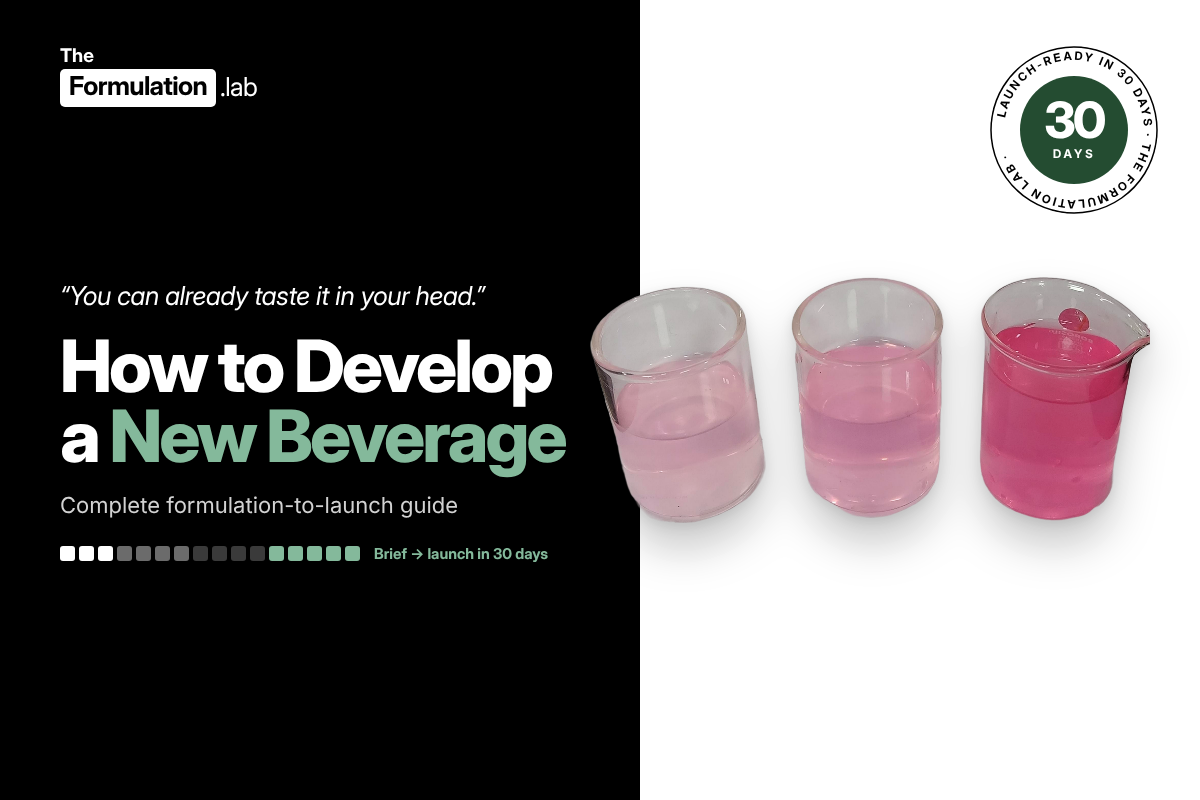
Beverage product development is the structured process of turning a beverage concept into a safe, stable, manufacturable and commercially viable product. It typically moves through concept definition, ingredient selection, beverage formulation, prototype development, sensory evaluation, processing trials, stability and shelf-life testing, regulatory review, packaging selection, scale-up and commercial production. For brands entering the Indian market, the development process also needs to account for FSSAI requirements, manufacturing capability, cost targets and the realities of production at commercial scale.
What Is Beverage Product Development?
The development of a beverage product links the creation of a concept with commercial production. This process is more involved than simply formulating a recipe since a successful product needs to be consistent out of the laboratory.A product can be a good-tasting beverage when tested on a small scale but can turn out bad on a larger scale due to sedimentation, flavour loss, separation, changes in carbonation, microbial instability or limitations in processing techniques.
A practical new beverage development process therefore evaluates:
- Product positioning and intended consumer
- Target sensory profile
- Ingredient functionality and compatibility
- pH, acidity, soluble solids and other relevant parameters
- Processing requirements
- Packaging compatibility
- Microbiological and chemical stability
- Regulatory and labelling requirements
- Manufacturing feasibility
- Target production cost and yield
The objective is to develop a formulation that can be reproduced consistently under defined manufacturing conditions.
Step 1: Define the Beverage Before Formulating It
The first development decision is not the ingredient list. It is the product specification.
Define:
- Beverage category and intended use
- Target serving size
- Flavour and sensory profile
- Still or carbonated format
- Ambient, chilled or other intended distribution conditions
- Desired shelf life
- Packaging format
- Target retail positioning
- Approximate cost target
- Relevant nutritional or functional requirements
This specification makes sure that formulation work is not simply a series of disconnected experiments.
For example, a high-protein beverage, fruit beverage, electrolyte drink and botanical drink can have very different formulation constraints even if they have the same packaging format.
Step 2: Select Ingredients for Function, Not Just Taste
Learning how to formulate a beverage requires understanding what each ingredient contributes to the finished system.
Water is the primary medium in many beverages, but acids, sweeteners, flavours, colours, stabilisers, proteins, fibres, minerals and other functional ingredients can significantly affect product behaviour.
Ingredient selection should consider:
- Solubility
- pH tolerance
- Heat sensitivity
- Interaction with other ingredients
- Sedimentation or precipitation potential
- Flavour compatibility
- Regulatory status and permitted use
- Supply consistency
- Cost at commercial volumes
A formulation can become unstable if ingredients interact differently after heating, dilution or storage. The case of protein-containing beverages is an example of such a formulation requiring careful control of pH, ionic conditions, heat treatment and stabilisation to minimise aggregation.
This is the point at which the technical formulation work provides greater value than just adjusting flavour and sweetness.
Step 3: Build and Screen Prototypes
Initial prototypes should test defined variables rather than changing everything simultaneously.
A development team may evaluate different levels of:
- Sweetness
- Acidity
- Flavour concentration
- Functional ingredients
- Stabilisation systems
- Solids content
- Colour
- Mouthfeel
Each prototype should be documented to enable traceability back to formulation decisions.
Sensory evaluation should be used to determine the levels of attributes such as flavour intensity, sweetness-acidity balance, aroma, aftertaste, mouthfeel, appearance and overall acceptability.
At this stage, the best formulation is not necessarily the one that tastes best straight away but must have a reasonable path to processing, stability and cost control.
Step 4: Evaluate Processing and Manufacturing Feasibility
A laboratory formula is only an intermediate product.
The next question is whether the formulation can survive the intended manufacturing process.
Depending on the beverage, relevant parameters may include:
- Mixing sequence
- Hydration time
- Temperature exposure
- Homogenisation
- Filtration
- Pasteurisation or other validated processing
- Filling conditions
- Carbonation
- Cooling and storage
Processing will change viscosity, flavour, colour, particle distribution and ingredient functionality.
A formulation may need to be altered after pilot trials; a good lab agitator may not perform well during industrial mixing.
Equipment availability, batch size, process losses, filling capability and expected yield should also be taken into account when considering manufacturing feasibility.
Step 5: Test Stability and Shelf Life
Shelf life should be supported by appropriate testing rather than assumed from the formulation.
Depending on the product, evaluation may include:
- Microbiological testing
- pH and acidity
- Total soluble solids
- Appearance
- Colour
- Sedimentation
- Phase separation
- Viscosity
- Flavour and aroma
- Nutrient or active-component retention where relevant
- Packaging interaction
Storage studies may identify problems that are not apparent immediately after production. A beverage may develop sediment, lose flavour, change colour or exhibit separation.The tests should be relevant to the actual intended storage and distribution conditions. While accelerated studies may allow potential instabilities to be identified, they should not be regarded as a substitute for real-time shelf life data.Professional development support may be appropriate if the mechanism of failure is not apparent. Troubleshooting may involve distinguishing between formulation, processing, packaging and microbiological causes rather than randomly altering ingredients.
Step 6: Check Packaging Compatibility
Packaging is part of beverage development, not simply a final purchasing decision.
The selected bottle, can, pouch, cap, liner or closure system must be compatible with the beverage and processing conditions.
Consider:
- Product acidity
- Thermal processing
- Oxygen and light exposure
- Carbonation pressure where applicable
- Migration and material suitability
- Closure integrity
- Filling conditions
- Storage environment
Packaging can influence flavour retention, oxidation, carbonation stability and physical integrity.
For new products, packaging trials should therefore be considered before final commercialisation rather than after the formulation has already been fixed.
Step 7: Address FSSAI and Labelling Requirements
FSSAI believes that for products manufactured and sold on the Indian market, regulatory oversight should be integrated into development, rather than deferred until artwork is complete.FSSAI states that food businesses are required to obtain the appropriate registration or licence under the regime of food safety and standards. Current information from FSSAI also makes a distinction between registration and licensing obligations based on the applicable criteria for a given business.Labelling of pre-packaged foods is governed by the Food Safety and Standards (Labelling and Display) Regulations, 2020, which have been amended from time to time, including the amendments notified by FSSAI in 2025 and 2026.
Regulatory review should consider:
- Product category
- Ingredient declarations
- Additive requirements
- Nutritional information
- Allergen declarations where applicable
- Date marking
- Net quantity
- Vegetarian/non-vegetarian declarations where applicable
- Claims and representations
- Packaging and labelling requirements
The exact regulatory position can depend on the beverage category and formulation. Current FSSAI regulations and amendments should therefore be checked before launch rather than relying on an older checklist.
Step 8: Build the Commercial Manufacturing Plan
Once the formulation is technically viable, the development process moves toward commercial production.A startup may choose its own facility, a private label arrangement, contract packaging, co-packing or an external manufacturing model.A food contract manufacturer may be considered when a brand requires access to production infrastructure without establishing its own manufacturing facility.
Other models can include:
- Third-party production
- Private label manufacturing
- Contract packaging
- Small batch manufacturing
- OEM food products
- Manufacturing through an appropriately licensed facility
When evaluating a manufacturing partner, review more than the quoted production price. Assess formulation ownership, confidentiality, NDA requirements, quality systems, batch documentation, production equipment, minimum order quantities, packaging capabilities and change-control procedures.A food manufacturing MOQ can have a significant impact on working capital. A low theoretical unit cost may be less attractive if the required production volume creates excessive inventory.Similarly, food contract manufacturing cost should be assessed against the complete production model, including ingredients, packaging, processing, testing, wastage, setup, storage and logistics where applicable.
Common Beverage Development Mistakes
Several problems can be reduced by addressing technical and commercial requirements early.
- Developing a recipe without a defined product specification
- Selecting ingredients based only on laboratory performance
- Ignoring processing effects until late-stage trials
- Establishing shelf life without appropriate stability evidence
- Designing packaging before understanding product compatibility
- Making claims before checking regulatory requirements
- Selecting a manufacturer based only on price
- Underestimating MOQ and packaging commitments
- Failing to document formulation changes
- Scaling directly from a kitchen or laboratory batch to commercial production
The most useful development workflow is iterative: formulate, test, analyse, optimise, pilot, validate and document.
When Is Specialist Beverage Development Support Useful?
Professional technical support can be particularly valuable when the product contains multiple functional ingredients, has demanding stability requirements, requires specialised processing or must transition from a laboratory prototype to commercial production.
Relevant expertise may include:
- Ingredient compatibility assessment
- Beverage formulation and reformulation
- Prototype optimisation
- Sensory evaluation
- Stability and shelf-life study design
- Process development
- Pilot-scale trials
- Manufacturing feasibility assessment
- Regulatory and labelling review
- Scale-up troubleshooting
The purpose is not simply to create a formulation. It is to identify technical risks early enough that they can be managed before commercial production.
Conclusion
Effective beverage product development requires more than a successful prototype. The formulation must remain stable, safe, sensory acceptable, regulatory appropriate, package-compatible and economically manufacturable.For the Indian beverage brands and start-ups, the most promising route towards development incorporates the connection of formulation decisions with processing, testing, FSSAI compliance, packaging and the manufacturing viability from the outset. Alternatively, where a brand lacks internal resources or faces technical challenges on scale-up, external expertise can help identify the best development and validation pathway.Get a Manufacturing Partner Shortlist when the formulation has reached the point where commercial production requirements, MOQ, quality systems and manufacturing feasibility need to be evaluated together.
FAQs
1.What is food contract manufacturing in India?
Food contract manufacturing in India is an arrangement in which a food brand engages an external manufacturer to produce products according to agreed formulation, quality, packaging and production requirements. The exact responsibilities can vary by agreement, so ownership, specifications, testing, packaging procurement and quality responsibilities should be documented clearly.
2.How does third-party food manufacturing work?
Third-party food manufacturing in India generally involves a brand working with an external licensed manufacturing facility to produce an agreed product. The process can include formulation transfer, raw material sourcing, pilot production, packaging, quality checks, batch production and documentation, depending on the commercial arrangement.
3.What is a food co-manufacturer?
A food co-manufacturer is an external producer that makes food or drink products for another company. Co-manufacturing can be utilised if there is a need for production capacity, specialised equipment, packaging ability or manufacturing infrastructure, but without the requirement to run the whole facility.
4.What does a contract food manufacturer do?
A contract food manufacturer produces products according to agreed specifications and manufacturing requirements. Depending on the contract, responsibilities may cover ingredient procurement, processing, filling, packaging, quality control, batch documentation and production support.
5.What is the difference between private label and contract manufacturing?
Private label generally involves the production of a product for sale under the brand of a customer, often using an existing product or manufacturing arrangement. Contract manufacturing can be more bespoke, with the brand providing or owning a particular formula, specification or development requirement.
6.What should a startup check before selecting a manufacturer?
A start-up should consider the following factors regarding potential production facilities: the applicable licence of the facility, manufacturing capabilities, quality controls, equipment, minimum order size, packaging capabilities, testing, documentation, confidentiality and ability to produce the required formulation in a consistent manner.
7.What is food manufacturing MOQ?
Food manufacturing MOQ stands for a minimum order quantity that a manufacturer is willing to produce in one production batch. MOQ may be affected by numerous characteristics, such as equipment setup, ingredient purchasing, packaging sizes, production economics, and batch size.
8.How much does food contract manufacturing cost?
Food contract manufacturing cost varies according to the formulation, ingredients, packaging, production volume, processing requirements, testing, setup requirements and other commercial factors. A meaningful costing exercise should therefore evaluate the complete product specification rather than relying on a generic per-unit estimate.
9.What is formulation ownership in contract manufacturing?
Formulation ownership determines who legally owns or controls the product formula and related technical documentation. It should be clarified in writing before commercial production, particularly where a brand has funded custom development or intends to manufacture the product with another facility later.
10.When should a beverage brand move from laboratory development to manufacturing trials?
A beverage should move toward manufacturing trials when its formulation has a defined specification, acceptable sensory performance, preliminary stability evidence and a realistic processing pathway. Pilot production can then identify scale-dependent issues before full commercial manufacture.