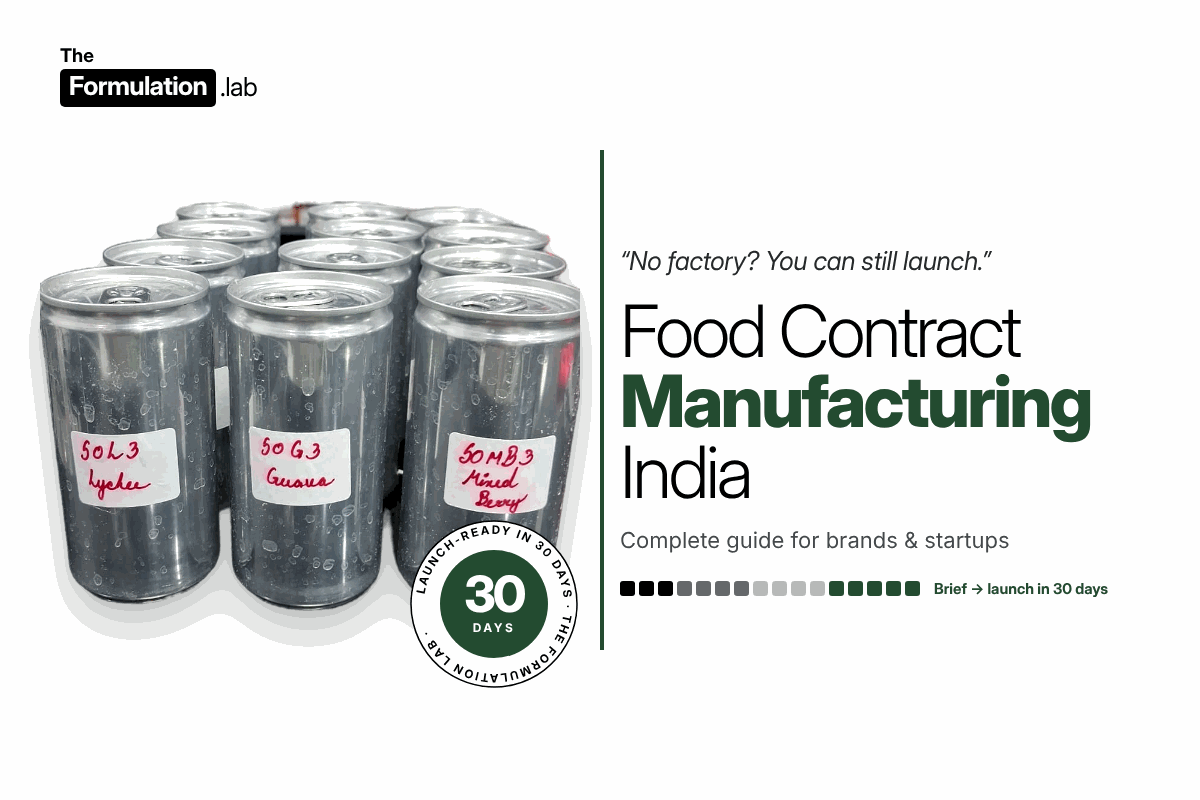
Food contract manufacturing in India allows a brand to develop and sell food products without owning and operating its own manufacturing facility. A brand typically defines the product, specifications, ingredients, packaging and commercial requirements, while a food contract manufacturer manages agreed manufacturing activities at its facility. Depending on the nature of the agreement, the relationship can encompass formulation support, sourcing, processing, quality control, packaging, documentation and batch production. For Startups and existing brands, the challenge is not only to find production capacity. More importantly, it is to ensure that a manufacturing partner will be able to reproduce the necessary product, comply with food safety and regulatory requirements, accommodate scale-up and be compatible with the brand’s commercial model.
What Is Food Contract Manufacturing in India?
Food contract manufacturing in India is a manufacturing arrangement in which a food brand engages an external facility to produce products according to agreed specifications.The brand may own the formulation, product concept, packaging specifications and intellectual property, while the manufacturing facility supplies some or all of the production infrastructure. The exact division of responsibilities depends on the contract.
Common arrangements include:
- Manufacturing finished food products to an established formula
- Producing private-label products
- Manufacturing products developed jointly with a technical team
- Contract packaging or co-packing
- Small batch manufacturing for early-stage products
- Large-scale commercial production
- Manufacturing under specific licensing or regulatory arrangements where applicable
The important distinction is that outsourcing production does not remove the need for technical control. Product specifications, approved ingredients, processing parameters, testing requirements, packaging materials and quality standards should be clearly defined before commercial production begins.
How Does Third-Party Food Manufacturing Work?
Third-party food manufacturing in India generally follows a structured progression from product requirements to commercial production.
1. Define the product requirements
The first step is to establish what is actually being manufactured. This includes:
- Product category
- Target consumer and intended market
- Ingredient requirements
- Nutritional objectives
- Sensory characteristics
- Pack size and format
- Expected shelf life
- Target production volume
- Packaging requirements
- Regulatory and labelling requirements
A vague product brief can create problems later because different manufacturers may interpret the same product requirement differently.
2. Assess manufacturing feasibility
A manufacturer will have to evaluate if their equipment, processes and quality systems are capable of producing the product.A formulation that works in the laboratory may have significantly different properties at commercial scale. Mixing intensity, heat transfer, cooling, filling, drying, extrusion, baking, or other unit operations may affect texture, moisture, yield, appearance and consistency.That’s where technical product development and manufacturing feasibility assessment come in to reduce avoidable production problems during scale-up.
3. Finalise formulation and specifications
The formulation should be accompanied by measurable specifications rather than relying solely on a sensory description.
Depending on the product, specifications may cover:
- Ingredient identity and permitted use
- Ingredient percentages
- Moisture or solids
- pH where relevant
- Texture
- Colour or appearance
- Weight or fill volume
- Microbiological requirements
- Nutritional parameters
- Packaging specifications
If a product is still being developed, formulation professionals may evaluate ingredient compatibility, processing behaviour, sensory performance and stability before transferring the product to commercial production.
4. Conduct trials and scale-up
Pilot or trial batches are used to confirm that the formulation will work under real manufacturing conditions.Scale-up may highlight problems that are not apparent at bench scale. A powder blend may need different mixing conditions at larger volumes. A sauce may behave differently with regard to viscosity or filling characteristics when made on an industrial scale. A baked product may show changes in moisture migration, texture or yield.The aim is to establish a repeatable manufacturing process rather than just produce one successful batch.
5. Validate production and begin commercial manufacturing
Once the formulation, process, packaging and quality requirements are established, then commercial production is possible under the agreed specifications.Batch records, raw material controls, process checks, finished-product testing and release procedures form the framework for ensuring production lots are consistent.
What Should Brands Check Before Choosing a Contract Food Manufacturer?
Selecting a contract food manufacturer should involve more than comparing quotations.A manufacturing shortlist should be evaluated against the actual requirements of the product.
Understanding Food Manufacturing MOQ
Food manufacturing MOQ means the minimum order quantity a manufacturer is willing or able to produce under specified commercial conditions.
MOQ can be influenced by:
- Minimum efficient batch size
- Ingredient purchasing quantities
- Packaging material requirements
- Equipment setup and cleaning
- Production scheduling
- Changeover time
- Labour requirements
- Storage and handling constraints
A low MOQ is attractive to startups, but it should be evaluated alongside unit economics. Very small production runs can result in higher per-unit costs because fixed setup, testing, packaging and production expenses are spread across fewer units.Instead of asking only, “What is the MOQ?”, a brand should ask how the MOQ is calculated and what changes when the production volume increases.
What Determines Food Contract Manufacturing Cost?
Food contract manufacturing cost depends on the product and manufacturing model rather than a single standard rate.
Major cost drivers may include:
- Ingredient cost and formulation complexity
- Processing time
- Production batch size
- Packaging format and material
- Labour and setup requirements
- Testing requirements
- Product losses and manufacturing yield
- Storage requirements
- Tooling or specialised equipment
- Minimum procurement quantities
- Logistics and handling
The quoted manufacturing price should therefore be viewed in the context of the entire cost structure.A lower manufacturing quote may not reflect a lower overall product cost if it does not include testing, packaging components, setup charges, development work or other necessary items.For startups, costing should be modelled at multiple production volumes. This will illustrate how unit economics might change as the product goes from early batches to steady commercial production.
Private Label, Contract Manufacturing and Co-Packing
These terms are related but should not be treated as interchangeable.Private label generally refers to products manufactured for sale under a brand’s own name. The product may be based on an existing formulation or developed according to specific requirements.Afood co-manufacturer arrangement in India typically involves an external manufacturer producing a brand’s product according to agreed specifications. The level of technical involvement can vary substantially.Co-packing is more specifically associated with packaging activities. A business may supply bulk product or other inputs while an external facility performs filling, packing, labelling or related operations.The contractual responsibilities should therefore be defined rather than inferred from terminology.
Formulation Ownership and Confidentiality
Formulation ownership should be addressed before development or manufacturing begins.
A contract should clarify:
- Who owns an existing formulation
- Who owns a newly developed formulation
- Whether manufacturing modifications can be reused elsewhere
- Ownership of technical specifications
- Treatment of process parameters
- Confidentiality requirements
- Access to development records
- Use of proprietary ingredients or processes
An NDA can help establish confidentiality expectations, but it should not replace a detailed commercial agreement covering intellectual property and technical ownership.This becomes particularly relevant when a startup has invested substantially in product development and intends to change manufacturing partners later.
Quality, Food Safety and Testing
A third-party food manufacturer should be able to work against clearly defined quality and food safety requirements appropriate to the product.Quality control may involve raw material inspection, process monitoring and finished-product evaluation. The specific testing programme depends on product characteristics and applicable requirements.
Testing may address:
- Microbiological quality
- Chemical parameters
- Nutritional composition
- Physical characteristics
- Moisture or water-related parameters
- Product-specific safety criteria
- Packaging integrity
Shelf-life evaluation is another important consideration. A declared shelf life should be supported by an appropriate evaluation strategy rather than being selected solely from a target marketing period.Packaging also matters because oxygen, moisture, light, temperature and package integrity can influence product stability. For some products, packaging selection should therefore be evaluated together with shelf-life requirements.
Regulatory and Labelling Responsibilities
An FSSAI-licensed facility is a fundamental consideration when assessing manufacturing arrangements in India, but the manufacturer’s licence status alone does not establish that a specific product is ready for market.Responsibility for regulatory compliance should be clearly allocated between the brand and manufacturer.
This may include:
- Product composition
- Ingredient compliance
- Label information
- Nutrition declaration
- Allergen-related information where applicable
- Claims and communication
- Batch identification
- Packaging information
- Required records and documentation
Where the formulation or claims are complex, regulatory review before commercial printing can help identify problems before packaging materials are committed to production.
Common Mistakes When Outsourcing Food Manufacturing
Several avoidable problems occur when brands focus on manufacturing price before defining technical requirements.
1.Choosing based only on MOQ
A low MOQ does not guarantee suitable equipment, quality systems or product compatibility.
2.Moving directly from kitchen trials to commercial production
A recipe developed in a small kitchen or laboratory may require reformulation or process adjustment for industrial equipment.
3.Leaving specifications informal
Terms such as “crunchy”, “natural colour” or “thick consistency” are difficult to control without measurable acceptance criteria.
4.Ignoring packaging during development
A product may perform adequately during formulation trials but lose quality because the selected packaging does not provide sufficient protection.
5.Comparing quotations without comparing scope
Two quotations may cover different combinations of manufacturing, packaging, testing, development and raw material responsibilities.
6.Failing to plan for scale
A manufacturing arrangement that works for 500 units may not automatically be suitable for substantially larger volumes.
When Is Specialist Technical Support Useful?
Professional formulation or product development support can be valuable when the product is not yet manufacturing-ready.
This may involve:
- Developing or reformulating the product
- Selecting compatible ingredients
- Optimising sensory characteristics
- Establishing process parameters
- Conducting prototype trials
- Evaluating stability
- Defining testing requirements
- Reviewing packaging compatibility
- Assessing manufacturing feasibility
- Supporting pilot-scale trials
- Troubleshooting production failures
- Preparing technical specifications
The aim is to bridge the formulation to the realities of commercial production. Most useful when a product has stability issues, inconsistent batches, problematic processing characteristics, unusual ingredient relationships or a challenging sensory target.Also, for brands comparing across several manufacturers, a checklist to guide manufacturing evaluations can help to bring consistency to the vetting process. The checklist should address technical capabilities, quality controls, MOQ, costing, documentation, ownership, testing, packaging and scale-up.
Conclusion
Successful food contract manufacturing in India depends on more than finding production capacity at an acceptable price. Brands must be aligned on formulation, manufacturability, quality controls, packaging, testing, regulatory responsibilities, ownership and commercial volumes.The most optimal manufacturing selection is driven by the total product specification and not based purely on MOQ, quotations or production volumes. This is particularly critical for both startups to avoid costly redesigns once manufacturing has commenced and for more established brands to enable tighter control of scale-up and supplier assessment.Prior to reaching out to manufacturers, establish the product specification, volumes, packaging, testing, ownership and target economics. Evaluate each manufacturer against the same selection criteria for a balanced assessment.
Get Expert Support for Food Contract Manufacturing
Turn your food product idea into a market-ready product with expert formulation, testing and manufacturing support.
FAQs
1. What is food contract manufacturing in India?
Food contract manufacturing in India is the outsourcing of food production to an external manufacturing facility under agreed product, quality and commercial specifications. The brand may retain ownership of the formulation, packaging specifications and intellectual property while the manufacturer performs production activities.
2. How does third-party food manufacturing work?
Third-party food manufacturing in India normally involves product specification, manufacturer evaluation, feasibility assessment, trials, formulation or process finalisation, packaging approval, production and quality release. Responsibilities for ingredients, testing, documentation and regulatory compliance should be defined contractually.
3. What is a food co-manufacturer?
A food co-manufacturer is an external manufacturing organisation that makes food products for a different company based on their specifications. The contract can vary from a simple manufacturing process to a more complex procedure accompanied by technical support, packaging, and scaling up.
4. What does a contract food manufacturer do?
A contract food manufacturer produces food products on behalf of a brand. Depending on the agreement, activities may include ingredient handling, processing, filling, packaging, quality control, batch documentation and production-scale execution.
5. What is the difference between private label and contract manufacturing?
Private label is terminology that usually refers to goods produced on behalf of another company, whereas contract manufacturing covers the manufacturing process itself. In this regard, the private-label product can be either an existing formulation or a formulation that was especially created for the brand.
6. How should a startup choose a food manufacturer?
A startup should evaluate product compatibility, MOQ, pricing, equipment, quality controls, testing, packaging, documentation, confidentiality, formulation ownership, and scale-up capability. Comparing manufacturers using the same checklist makes evaluation more informative than comparing quotations.
7. What is food manufacturing MOQ?
Food manufacturing MOQ is the minimum quantity a manufacturer requires for a production run. It may depend on batch size, equipment setup, raw material procurement, packaging quantities and production efficiency.
8. How much does food contract manufacturing cost in India?
Food contract manufacturing cost varies according to formulation, ingredients, processing, batch size, packaging, testing and other production requirements. A meaningful comparison should examine the full scope of each quotation rather than comparing only the per-unit manufacturing price.
9. Can a manufacturer help scale a product from pilot to commercial production?
Yes. A suitable manufacturing plan may involve scale-up trials which assess apparatus, processing parameters, yield, batch uniformity and product quality. Scale-up is particularly valuable when laboratory or pilot findings cannot be translated directly into commercial apparatus.
10. Should formulation ownership be included in the manufacturing agreement?
Yes. The agreement should provide for ownership of existing and newly developed formulations, specifications, process information and other proprietary technical information. Issues of confidentiality and intellectual property are particularly relevant if there has been substantial product development prior to commercial manufacturing.