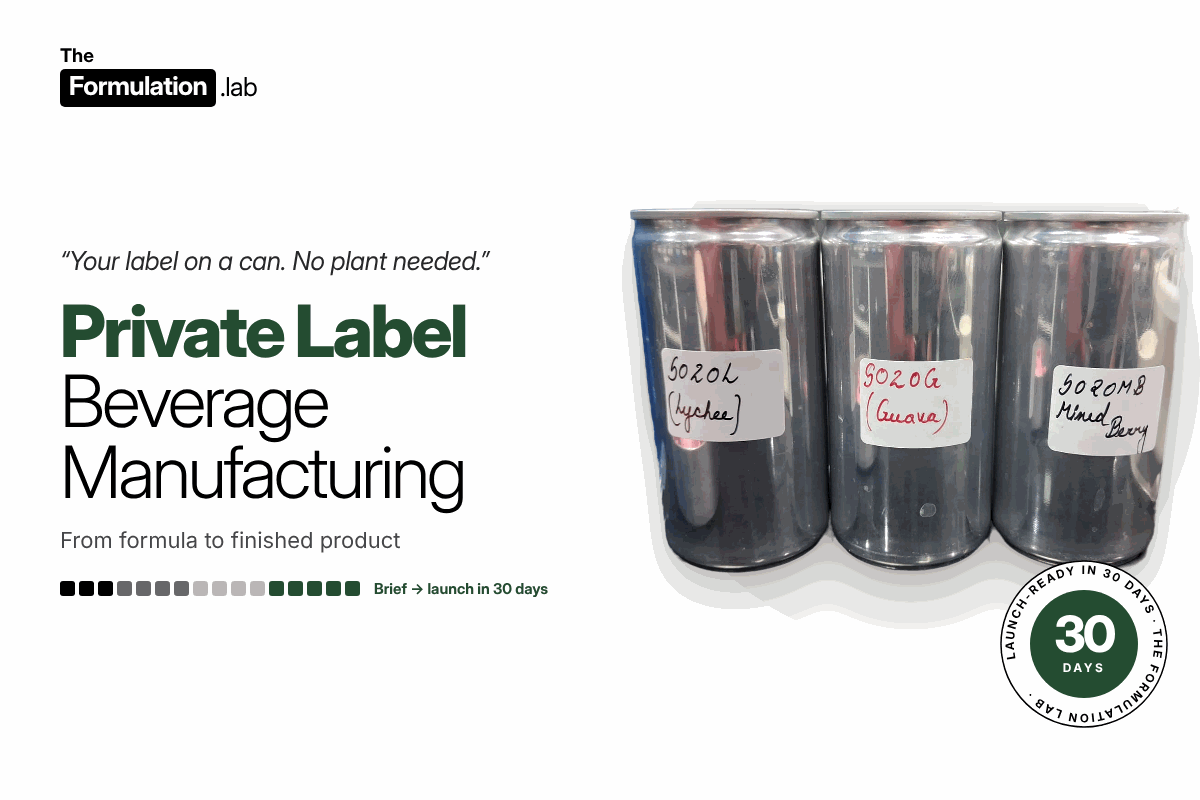
Private label beverage manufacturing allows a business to sell drinks under its own brand while an external manufacturing partner produces them. Depending on the arrangement, the manufacturer may supply a ready-made formula, adapt an existing beverage, or support the development of a new product. For brands entering the Indian beverage market, the decision involves more than selecting a bottling facility. Formula ownership, minimum order quantity (MOQ), processing capability, packaging compatibility, shelf-life validation, regulatory compliance and production economics all influence whether a product can move successfully from concept to commercial sale.
What Is Private Label Beverage Manufacturing?
Private label beverage manufacturing is a production arrangement in which a manufacturer makes beverages for sale under another business’s brand name. The brand owner typically manages market positioning, distribution and sales, while the manufacturing partner handles agreed production activities.The scope of responsibility varies by contract. Some manufacturers provide established beverage formulations and standard packaging options. Others support ingredient selection, prototype development, process optimisation, filling, packaging and product validation.
Common product categories include:
- Carbonated soft drinks and flavoured beverages
- Fruit-based drinks and juice beverages
- Functional beverages and fortified drinks
- Energy drinks and sports beverages
- Ready-to-drink tea and coffee
- Flavoured water and electrolyte drinks
- Syrups, concentrates and beverage mixes
The right arrangement depends on the product concept, the level of customisation required, the brand’s investment capacity and the manufacturer’s technical capabilities.For a business evaluating private label beverages, the first decision is whether an existing product can meet its requirements or whether a differentiated formulation is necessary.
Private Label vs White Label Beverage Manufacturing
The terms private label and white label are sometimes used interchangeably, although manufacturers may distinguish between them.
White label beverage manufacturing generally refers to purchasing an existing product that can be marketed under different customers’ brands. The formula, processing method and product specifications are usually already established, with customisation concentrated on branding and packaging.Private labelling can also use an existing formula, but the arrangement may include greater control over formulation, specifications, flavour profile or product positioning. The exact distinction depends on the manufacturer’s commercial model rather than a universal industry definition.
Neither of these options guarantees brand ownership of the underlying formula. Exclusivity, intellectual property rights, allowed alterations and restrictions on selling similar products should be explicitly documented.The ready-made formula may be appropriate for a business testing the demand with a limited initial investment. A custom formulation may be more appropriate where flavour, nutritional composition, ingredient profile or the performance of the product is key to the brand’s positioning.
How Private Label Beverage Manufacturing Works
A reliable manufacturing arrangement follows a defined path from product requirements to repeatable commercial production.
1. Define the product and business requirements
Begin with a written product brief covering:
- Beverage category and intended consumer
- Desired flavour, sweetness, acidity and mouthfeel
- Ingredient preferences and restrictions
- Pack format, volume and serving size
- Target retail price and expected manufacturing cost
- Intended distribution channels and storage conditions
- Proposed launch volume and future production requirements
These decisions affect equipment selection, ingredient costs, packaging options and process requirements. A beverage designed for refrigerated distribution may require a different manufacturing and logistics model from an ambient-stable drink.
2. Select an existing formula or develop a new one
The next step is to determine whether the manufacturers’ current portfolio could meet your brief. Take a look at existing formulas, requesting the product specification, ingredient declaration, available formats of packaging and any relevant stability information. Confirm that permitted changes may be made and whether the finished product will meet your brand’s labelling and quality requirements.Private label drink formulation becomes more involved when the product needs a distinct sensory profile, functional ingredients, a particular nutritional composition or specific ingredient exclusions.Development can involve ingredient screening, bench-scale prototypes, controlled sensory trials and adjustments to sweetness, acidity, flavour intensity, solubility, or texture.Changes must be considered in a complete formulation. For example, replacing sugar with a high-intensity sweetener can impact not only sweetness but also body, flavour balance and the need for other formulation adjustments.
3. Confirm manufacturing feasibility
A successful laboratory sample does not guarantee a commercially viable beverage.The manufacturer should determine if the formula can be processed using its processing and filling equipment. Considerations include viscosity, foaming, suspended particles, carbonation, heat sensitivity and the effects of processing on ingredients.For example, a beverage with fruit solids may need special mixing and filling procedures to ensure consistency. A heat-sensitive functional ingredient may necessitate a review of the processing conditions and the stability of the ingredient.At this stage, determine whether pilot trials are required and what product characteristics need to be retained at scale-up.
4. Finalise packaging and label design
The packaging concept directly impacts the product’s safety, production process efficiency, transportation costs, and consumer convenience.The most common types of packaging are PET bottles, glass bottles, cans, cartons, and other containers that are suitable for storing various drinks. Therefore, the packaging material depends on the product’s acidity, level of carbonation, processing method, sensitivity to light, and distribution conditions.
Before approving a pack, confirm:
- Container compatibility with the beverage
- Suitability for the intended filling and processing method
- Closure integrity and leakage performance
- Protection against oxygen and light where relevant
- Label adhesion and resistance to expected handling conditions
- Availability, lead times and minimum purchase quantities
Packaging should be evaluated alongside the formulation rather than treated as a final branding decision.
5. Validate the product and approve specifications
Before going into commercial production, it should be established that the beverage conforms to established quality and safety standards.
Depending on the nature of the product and process, assessment can include microbiological analysis, physicochemical determinations, sensory evaluation, packaging conformity and stability trials.A specification for the end product should be agreed upon, which includes quantifiable criteria for acceptance, such as pH, soluble solids (where appropriate), carbonation level, appearance, flavour characteristics and volume of fill. Those microbiological and chemical requirements applicable to the product should be specified.The manufacturer and brand owner should agree procedures for sampling, documentation of a batch, deviation from specifications and approval of finished products.
6. Move into commercial production
Once formulation, packing, process and quality criteria are approved, production planning can proceed.Confirm purchase order, availability of raw materials, production schedule, packaging stock and finished goods dispatch arrangements. The first commercial batch should be checked against the approved specification.Production records and retained samples, where appropriate, facilitate the investigation of complaints and comparison of later batches with the initially approved product.
Key Technical Considerations When Choosing a Beverage Manufacturer
The technical capability of a manufacturing partner should match the beverage being developed. A facility experienced in one category may not have the equipment or process expertise needed for another.
Formulation stability and shelf life
A beverage can undergo physical, chemical or microbiological changes during storage. Physical changes may include sedimentation, clouding, separation or changes in colour. Chemical changes may affect the organoleptic properties and nutrient content. The microbiological risk depends upon the ingredients, the nature of processing, packaging and the storage conditions.Appropriate data shall be used to substantiate shelf life claims, rather than making assumptions based on the category of a similar existing product.
A suitable evaluation plan may include:
- Monitoring relevant physicochemical properties over time
- Assessing sensory changes during storage
- Conducting microbiological testing appropriate to the product and process
- Evaluating packaging integrity and compatibility
- Reviewing expected storage and distribution conditions
Accelerated studies can help investigate certain degradation mechanisms, but they do not automatically replace real-time shelf-life evaluation.
Processing and food safety
The necessary process depends on the formulation and the safety characteristics of the product. Depending on the nature of the beverage, manufacturing may require hot filling, pasteurisation, aseptic processing, carbonation or other controlled processes.For products requiring a validated microbial reduction step, the process shall be suitable for the type of beverage and its packaging. The presence of acidity alone shall not be considered as an assurance of safety or shelf stability.
Ask how key process parameters are monitored, what action is taken for deviations and what evidence supports the proposed processing method.
Quality assurance and batch consistency
A written quality system should establish controls for incoming ingredients, production, filling and finished goods.
Useful questions include:
- How are raw materials checked against specifications?
- How are batch records maintained?
- Which in-process parameters are monitored?
- How are non-conforming batches investigated?
- What happens when a supplier changes an ingredient specification?
- How are complaints, recalls and traceability managed?
These controls become particularly relevant when a product moves from small production runs to larger volumes.
Private Label Beverage MOQ, Cost and Commercial Feasibility
The private label beverage MOQ is the minimum quantity a manufacturer will accept for a production order. It may be expressed in bottles, cans, cases, litres or batches, depending on the production model.There is no universal MOQ for private label drinks. It depends on the filling line, product type, batch size, packaging format, changeover requirements and raw material purchasing conditions.
A low initial production volume may be possible for some products but commercially inefficient for others.
What determines manufacturing cost?
The total cost of a beverage can include:
- Ingredients, flavours, sweeteners and functional components
- Processing, labour and production overheads
- Bottles, cans, closures, labels and secondary packaging
- Formulation development and pilot trials
- Laboratory testing and shelf-life evaluation
- Artwork preparation, printing setup and packaging tooling where applicable
- Storage, freight and distribution
- Wastage, production yield and quality-related losses
A quoted unit price should be reviewed alongside its assumptions. Clarify whether development, testing, packaging procurement, freight and taxes are included or charged separately.
Cost comparisons are more useful when suppliers quote against the same product specification, pack size, order volume and delivery terms.
How can a brand manage MOQ risk?
Before committing to a large order, estimate demand using realistic sales assumptions. Include inventory holding, expiry risk, cash-flow requirements and packaging commitments.Where appropriate, discuss whether a pilot run, a smaller initial production batch or standard packaging can reduce upfront exposure. However, smaller runs may carry higher per-unit costs and may not be technically or commercially available.
Request MOQ and costing guidance based on the proposed beverage category, packaging format and expected order volume before finalising the product brief.
Regulatory and Labelling Considerations in India
The brand owner and manufacturer should agree their respective compliance responsibilities before production commences.
Requirements will vary depending on beverage category, ingredients, intended claims, manufacturing arrangement and applicable Indian food regulations. Applicable checks may include food business licensing, product category classification, permitted ingredients and additives, applicable standards, labelling declarations and claims compliance.The final label should be assessed against the requirements applicable to the specific product. Depending on the product and packaging, declarations may include the ingredient list, nutrition information, allergen information where applicable, net quantity, date marking, storage instructions, manufacturer/packer details and other required particulars.Functional, nutritional and health-related claims require particular scrutiny. Presence of an ingredient does not necessarily support a claim about the finished beverage.Before printing labels or ordering large quantities of packaging, confirm that the product specification, ingredient composition and proposed claims are compatible with applicable requirements.
How to Evaluate and Shortlist a Private Label Beverage Manufacturer
A useful shortlist assesses technical fit and commercial reliability rather than relying on the lowest quotation.
Use the following checklist during supplier discussions:
- Category fit: Can the facility manufacture the specific beverage type?
- Technical capability: Does it have suitable processing and filling equipment?
- Development support: Can it work with existing formulas or develop a new formulation when required?
- Quality systems: Are testing, traceability, batch records and deviation procedures documented?
- Shelf-life evidence: Can the proposed product and process be validated appropriately?
- Packaging options: Are the available formats compatible with the product and target market?
- MOQ and pricing: Are minimum volumes, cost components and payment terms transparent?
- Regulatory responsibilities: Are label review, product classification and documentation responsibilities clearly allocated?
- Intellectual property: Are formula ownership, confidentiality, modification rights and exclusivity addressed contractually?
- Scalability: Can production volumes increase without compromising specification or consistency?
- Supply continuity: Are ingredient sourcing, packaging availability and lead times understood?
- Commercial terms: Are rejection criteria, complaint handling, recalls and delivery obligations documented?
A manufacturer should be assessed according to the requirements of the particular product. A facility that has the right equipment, clear controls and a viable development path may represent a better long-term option than a less expensive alternative whose capabilities are not compatible with the brief.When the product requires specialist formulation, stability investigation or process validation, independent technical input can help specify requirements, judge feasibility and provide a benchmark against which to evaluate manufacturer proposals.
Common Mistakes to Avoid
Brands can reduce avoidable development and procurement risks by addressing several issues before signing a manufacturing agreement.
- Selecting a supplier before defining the product: An incomplete brief leads to inconsistent quotations and unsuitable recommendations.
- Assuming a ready formula is exclusive: Exclusivity and ownership must be agreed in writing.
- Approving a laboratory sample without scale-up trials: Mixing, heat transfer and filling behaviour may change at production scale.
- Treating shelf life as a standard category value: The actual formulation, process and packaging determine the evidence required.
- Comparing unit prices without total costs: Development fees, packaging commitments and testing can materially change the economics.
- Printing labels too early: Changes to ingredients, claims or mandatory declarations can make artwork unusable.
- Leaving responsibilities undefined: Contracts should identify who approves specifications, manages testing, handles complaints, and coordinates recalls.
A structured evaluation process helps expose these issues before commercial commitments become difficult to reverse.
Conclusion: Choose the Manufacturing Model That Fits the Product
Successful private label beverage manufacturing depends on matching the product concept with the right formulation pathway, processing capability, packaging, quality controls and production economics. An existing formula may support a faster route to market, while a custom beverage requires more development, validation and ownership planning.Before selecting a manufacturing partner, establish the product specification, acceptable MOQ, target cost, evidence required for shelf life and responsibilities for regulatory compliance. Compare prospective manufacturers against these requirements rather than price alone.
Get a Manufacturing Partner Shortlist by defining the beverage category, formula requirements, packaging preferences, expected order volume and target launch timeline.
Launch Your Own Beverage Brand
Looking for a reliable beverage manufacturing partner? Get expert support with formulation, packaging, and product development.
FAQs About Private Label Beverage Manufacturing
1. What is a private label beverage manufacturer?
A private label beverage manufacturer is a company that makes soft drinks that are then sold by another business under their brand label. Depending on the contract, the manufacturer can be involved in the product development, sourcing of ingredients, production, filling, packaging, and quality control of the product. The brand owner will usually manage the selling and marketing of the product, but responsibility for regulations and quality control must be given to one party or the other depending on the contract.
2. What is private label beverage manufacturing?
Private label beverage manufacturing is the process of producing beverages for a brand that does not necessarily own or operate its own manufacturing facility. It can involve an existing formula, a customised product or a newly developed drink. The scope depends on the manufacturer’s capabilities and the agreed commercial arrangement.
3. What is the difference between private label and white label beverage manufacturing?
White label beverage manufacturing usually involves an existing, standardised product that multiple businesses can sell under different brand identities. Private labelling may also use existing formulas but can include more control over specifications and customisation. Neither arrangement automatically provides formula ownership or exclusivity; these rights must be confirmed in the contract.
4. Can a private label beverage manufacturer develop a completely new formula?
Yes, some manufacturers will support the development of a new formulation but with very different levels of capability. Development may involve ingredient selection, prototype trials, sensory evaluation, process development, packaging assessment and shelf-life validation. Brands should always check what activities are available, how development costs are apportioned and who owns the resulting formulation before any work starts.
5. What is the minimum order quantity for private label beverages?
The minimum order quantity depends on the type of beverage, the production equipment, the batch size requirements and the packaging. Some manufacturers may have smaller minimums for certain products, whilst some types of processing or packaging may require a larger commitment. Request a quotation giving details of minimum volume, unit cost, set-up charges and any purchasing requirements for packaging.
6. How much does private label beverage manufacturing cost in India?
There is no standard cost as ingredient make-up, processing and packaging plus additional batch size, and testing requirements will vary from product to product. Bespoke formulation could incur development costs, whereas larger production runs may lower individual costs. A quotation will require specification of product, pack format, target volume and inclusions to cost.
7. Can a brand customise the flavour and ingredients of a private label drink?
Customisation is subject to the terms of the manufacturing agreement and the capacities of the facility. Some agreements only allow changes to the label and the packaging, whereas others permit changes to the flavour, sweetness, acidity or selected ingredients. Any change should be assessed for ingredient compatibility, sensory attributes, processability, stability and regulatory compliance.
8. Who owns the beverage formula in a private label arrangement?
The ownership of the formula is determined by the terms of the agreement and the source of the formulation. The manufacturer can own the existing formula; the newly created formulation can be the subject of another agreement. It is vital to establish the confidentiality of the formula, the right to use it, make changes, and the possibility of exclusivity and the conditions for termination of the manufacturing agreement.
9. How is the shelf life of a private label beverage determined?
Shelf life is determined based on appropriate product-specific evidence relating to formulation, processing, packaging and proposed storage conditions. Such evaluation may include microbiological, physicochemical, sensory and packaging integrity assessments. While accelerated testing may provide useful supporting data, the design of the study must be representative of the actual risks presented by the product and the intended conditions of sale.
10. What should a brand check before choosing a private label beverage manufacturer?
A brand should evaluate category experience, processing capability, MOQ, total cost, quality controls, shelf life validation, packaging options, regulatory responsibilities and production scalability. Formula ownership, exclusivity, lead times and complaint handling procedures should also be covered in documentation. Comparing manufacturers against a consistent brief for the product will highlight technical and commercial differences.